Moving abroad often surprises people because practical tasks like visas, shipping, schools, and finding a place to live get all the attention because of their deadlines.
The financial side, which has no set deadlines, is often overlooked. However, the financial choices you make before you leave are usually the hardest to change later.
Some opportunities end as soon as you are no longer a UK resident. Others remain, but they can become much more costly. Go through this checklist now, while you still have all your options. We’ve also added links to articles that dive deeper into important topics.
1. Understand when you actually stop being a UK resident
Everything else depends on this, so start here. Your UK tax residence doesn't depend on your flight date or your new address. Instead, the Statutory Residence Test decides it by looking at how many days you spend in the UK and your connections to the country.
Two things are especially important. Split-year treatment may apply in the year you leave, which means you are taxed as a resident for the part of the year before you go and as a non-resident after you leave. This can make a real difference if you have income or gains on either side of your move.
Because so much depends on the tax year, departing in March rather than April (or vice versa) can materially change your position.
2. Tell HMRC you're leaving
If you have been taxed under PAYE, you usually need to submit Form P85 to let HMRC know you are leaving. This can also trigger a refund if you paid too much tax in the year you leave.
A common misunderstanding is that filing a P85 makes you non-resident. It only tells HMRC about your plans. The Statutory Residence Test decides your real status. You can file a P85 and still be a UK resident for that year if the test says so.
If you still have UK income, such as rental profits or a pension, you may also need to register for Self Assessment. In some cases, you should apply for an NT ("no tax") code, so your pension income is paid in full rather than taxed at source and reclaimed later.
3. Protect your State Pension and note what changed in April 2026
This is the most urgent item on the list, and the situation has become much tougher recently.
Once you leave, you usually stop building qualifying years for your UK State Pension. You can fill the gap with voluntary National Insurance contributions, but the rules became much stricter from 6 April 2026:
No more voluntary Class 2 contributions for time abroad:
They cost roughly £3.65 a week.
Class 3 is now the only option:
At £18.40 a week (about £957 a year for 2026/27), it costs about five times as much.
New applicants face a 10-year test:
You need either 10 continuous years of UK residence or 10 qualifying years of UK National Insurance contributions before going abroad.
Even at Class 3 rates, the numbers can still make sense. The payback period is often less than three years of pension payments. However, this is now a much bigger decision than before, and the new eligibility test means some people cannot do it at all.
Before you leave, get a State Pension forecast, check your National Insurance record for any gaps, and find out if you can contribute from abroad. You apply using form CF83. Also, remember that in many countries, your State Pension will not increase each year.
→ The frozen State Pension trap
4. Use your ISA allowance while you still can
You cannot add money to an ISA once you are no longer a UK resident. You keep what you already have, and it keeps growing tax-free in the UK. If you return, your allowance starts again, but you cannot make new contributions while abroad.
So if you have room in your ISA and the money to use it, the tax year you leave is your last chance for now. You also need to tell your ISA provider once you are no longer a UK resident.
One thing to check: your ISA is free of UK tax, but not always free of foreign tax. For example, the UAE will not tax it, but France, Spain, or the US usually will.
5. Sort your pensions and be sceptical of what you're offered
Review your UK pensions before you leave, while you still have easy access to UK providers and advice. It is easier to consolidate scattered pots, check how they are invested, and update expression-of-wish forms now than from a different time zone.
A clear warning: newly arrived expats are often targeted with overseas pension transfer offers. Moving a UK pension abroad can trigger a 25% overseas transfer charge, and transferring to a scheme that is not a genuine QROPS can mean unauthorised-payment charges of 40% or more.
For most people, keeping the pension within the UK system is the safest choice.
→ QROPS vs SIPP vs leaving it in the UK · The transfer charges that catch expats out
6. Decide what happens to your UK property
If you keep your property and rent it out, you will fall under the Non-Resident Landlord Scheme. This means your agent or tenant must withhold basic-rate tax from your rent unless you apply to HMRC (form NRL1) to receive it in full. You will usually still need to file a UK tax return.
If you are selling, timing is important. Selling before you leave may let you keep full private residence relief. Selling later means non-resident capital gains tax applies, with a strict 60-day reporting and payment deadline after completion.
→ Funding a UK property from abroad
7. Keep your UK banking and credit alive
It may seem mundane, but this can be a major source of frustration later. Some UK banks close or restrict accounts for non-residents, and re-opening from overseas is much harder than keeping an account open.
Before you go, check with your bank what happens to each account when you change your address abroad. If you can, keep at least one UK account open, and keep some small, regular UK credit activity going. Years abroad with no UK footprint can make you look like a stranger to lenders when you return.
8. Check your investments will travel
Many UK investment platforms do not accept non-resident clients, and some will ask you to close or move your account once you update your address. Find out before you are forced into a rushed decision, and learn what your options are in your new country.
9. Plan the currency, don't just accept it
If you are converting a large amount, such as savings, property proceeds, or a lump sum, the exchange rate on the day can change the outcome by thousands. Plan your approach instead of converting at whatever rate is available when you arrive.
→ The cost of moving money · What the pound has done this decade
10. Update your will and estate plan
Your UK will may not cover assets you acquire abroad, and some countries have forced heirship or default succession rules that override it completely. The UAE is a notable example for non-Muslims without a registered local will.
Review your will before you go, and plan for a local will in your new country if you will have significant assets there. Also, UK inheritance tax now follows residence rather than domicile, and it may still affect you for years after you leave.
→ Wills and trusts for British expats · UK inheritance tax for expats
11. Mind the insurance gap
Your NHS access ends when you stop being ordinarily resident, so you should have health cover abroad before you travel. The riskiest time is the gap between leaving and your new cover starting. Also check if your UK life or income protection policies remain valid once you live overseas; many do not.
→ Expat healthcare: the best and worst countries
12. If there's any chance you'll come back
Think about the temporary non-residence rule before making large gains. If you return to the UK within about five years, you may be taxed on some gains you made while you were away. Leaving isn't always enough; you need to stay away long enough.
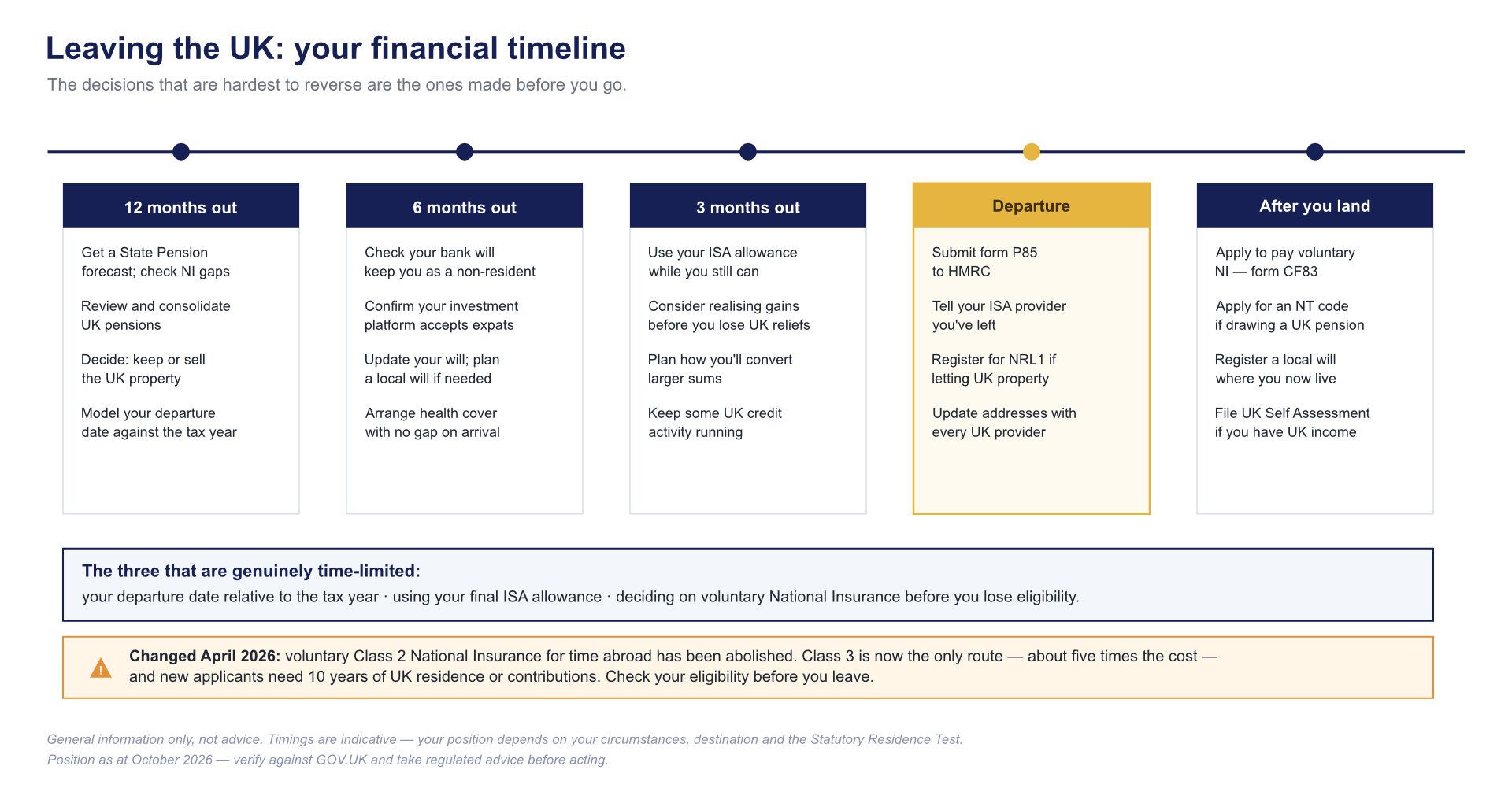
The pre-departure checklist
Confirm when you'll become non-resident (SRT) and whether split-year applies
Submit form P85 to HMRC; register for Self Assessment if you'll have UK income
Get a State Pension forecast; check NI gaps; assess Class 3 eligibility (form CF83)
Use your ISA allowance; tell your provider when you leave
Review and consolidate pensions; ignore unsolicited transfer pitches
Decide on UK property — sell before, or register for NRL1
Confirm which bank accounts survive; keep UK credit activity alive
Check your investment platform accepts non-residents
Plan your currency conversions
Update your will; plan a local will for your destination
Arrange health cover with no gap; check life cover still applies
If you may return within five years, check the temporary non-residence rule
Few people manage to do all twelve, and that is fine. But the top items on the list—residence timing, the State Pension decision, and the ISA allowance—are genuinely time-limited, so they are the ones worth doing first.
If you would like help working through this before you go, while all your options are still open, talk to Holborn Assets.
All information contained in this article was correct at the time of publication. This article is for informational purposes only and is not financial advice. For personal financial advice, always speak to a regulated professional.
Don’t just take our word for it...
We’re rated 4.8 out of 5 on Feefo, based on verified reviews from real client experiences
 4.8 / 5