Most people know the basics: a will explains who gets your assets after you die, while a trust holds assets for someone else.
But fewer people realise that if you live abroad or own assets overseas, these tools can work very differently.
Here’s a quick look at wills and trusts and how they differ, followed by what you need to know if you have ties to more than one country.
In brief: the difference between a will and a trust
Wills and trusts are both core components of estate planning.
What is a will?
A will is a legal document that explains who inherits your assets, who carries out your wishes as executor, and who cares for your children. It takes effect only after you die and usually must go through probate, the legal process of proving the will and giving someone authority to manage your estate.
What is a trust?
A trust is a legal arrangement in which you transfer assets to trustees, who manage them for the people you choose, called beneficiaries. A trust can start while you are alive or after you die. Assets in a trust are not part of your personal estate, and the details are kept private.
The practical distinction
A will decides what happens to your assets after you die, but a trust changes who owns those assets before then. Because of this, trusts can sometimes offer more control, more privacy, and, in some cases, different tax benefits.
Let’s clear up a common myth. You might read that trusts are a way to "avoid probate". This idea comes from the United States, where revocable living trusts are used for that reason. In the UK, things work differently.
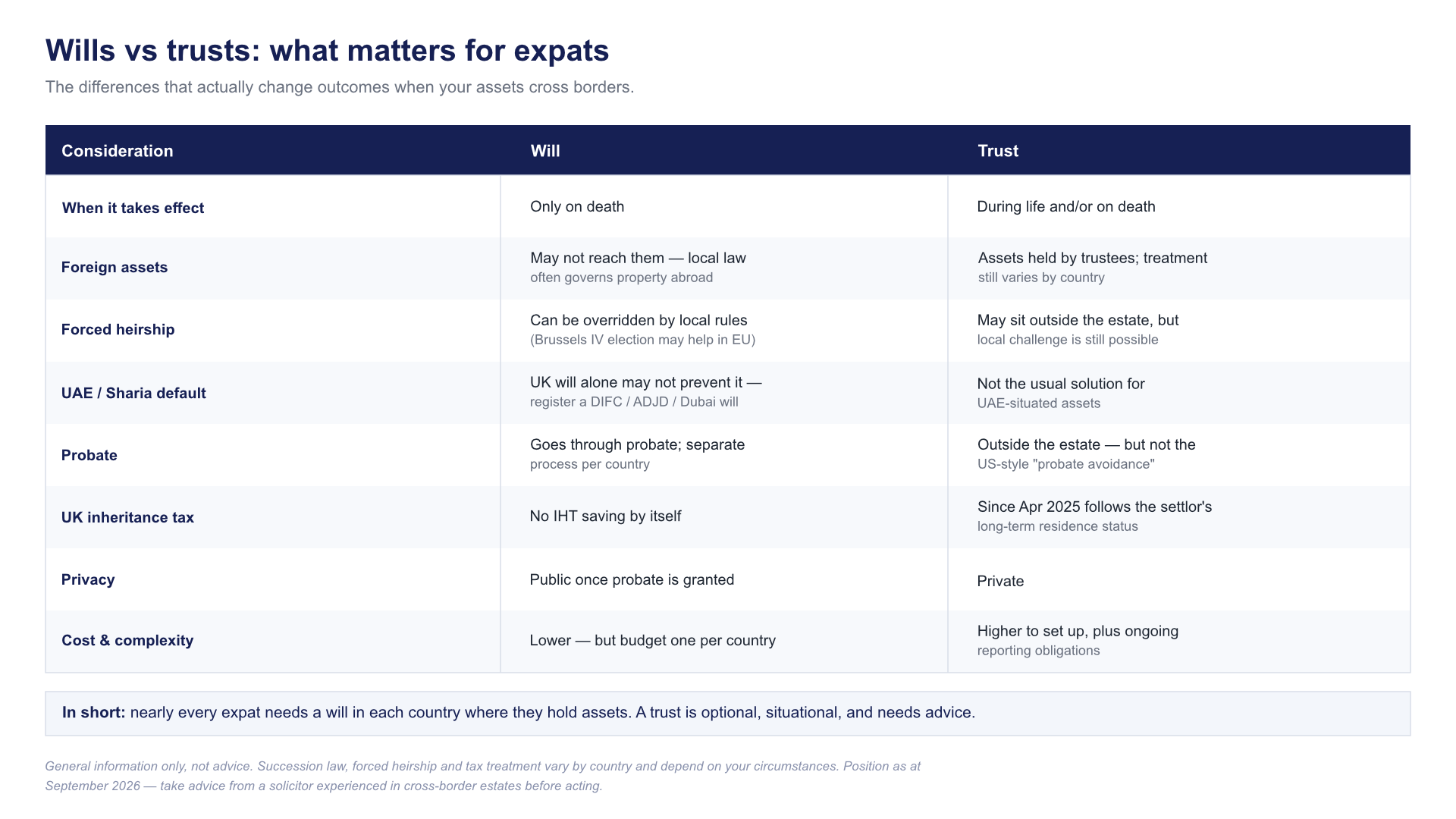
Assets in a properly set up trust are held outside your estate, so they are not included in the grant. However, this is not the straightforward probate-avoidance method that trusts in the US can provide. UK trusts also have their own tax and reporting rules.
Where it gets complicated: living abroad
Here's what the standard guides don't tell you.
Your UK will may not cover your foreign assets
If you are an expat living overseas or have assets abroad, check whether your UK will is valid.
A UK will usually works for UK assets. Whether it covers assets in other countries depends on those countries' laws. For land and property, most countries use their own rules, no matter what your will says. So, a British expat with a UK will, a Dubai apartment, and a holiday home in Spain may find the UK will covers only part of the estate.
This is why many families with assets in different countries use separate wills for each place. For example, a UK will for UK assets, a Spanish will for Spanish property, and a UAE will for UAE assets. This speeds up the process in each country and stops one estate from delaying another.
Be careful: each will must be written so it does not cancel the others. A standard "this revokes all previous wills" clause in a second will can accidentally cancel the first, which is a common and costly mistake. It’s important to have these wills drafted together by someone experienced in cross-border work.
Forced heirship can override your wishes
In England and Wales, you have broad testamentary freedom. You can leave your estate to whoever you like. In many other countries, things are different.
Civil-law countries such as France, Spain, Italy, and many others apply forced heirship. This means fixed reserved shares must go to children, and sometimes a spouse or parents, no matter what your will says. You can't simply disinherit them.
There is a route around it in the EU. Under EU Regulation 650/2012 ("Brussels IV"), in force since August 2015, you can elect in your will for the law of your nationality to govern your succession rather than the law of where you live.
For a British national living in Spain or France, making that election explicitly in the will can restore English testamentary freedom over the distribution. It does not change local tax, only which succession law applies, and it must be drafted properly to work.
If you're in the Gulf, this is the section that matters
The rules in the UAE often surprise British expats the most.
The UAE's succession framework is grounded in Sharia principles. Without a valid, registered UAE will, those rules have often been applied to the UAE assets of non-Muslim expatriates, regardless of nationality or religion.
In practice, this can mean a Dubai property or UAE bank account is divided into fixed shares that do not match what a British couple intended. It often shocks a surviving spouse who assumed they would inherit everything.
Recent reforms have made it much easier to opt out. Non-Muslims can now register a will that applies their own national law, principally through:
The DIFC Wills Service Centre (the long-established route, covering assets in Dubai and Abu Dhabi, run on common-law principles);
The Abu Dhabi Judicial Department (ADJD) non-Muslim wills registry; and
Dubai Courts wills registration.
For a non-Muslim expat with UAE assets, especially property, a business, or guardianship concerns for young children, registering a UAE will is almost essential. It does not replace a UK will; it works alongside it and covers your UAE assets.
Trusts and the new residence-based tax rules
If you’re considering a trust as an expat, things have changed. Since April 2025, the UK’s inheritance tax system is based on long-term residence instead of domicile, and trusts now generally follow the settlor’s residence status.
The old approach, where a non-dom could put assets into an offshore trust and get permanent excluded-property protection, no longer works the same way.
Trusts still have real uses for expat families, such as protecting assets for children, providing for vulnerable beneficiaries, keeping arrangements private, and holding assets across generations. But they no longer reliably keep worldwide wealth permanently outside UK inheritance tax, and setting one up incorrectly can create tax charges instead of saving them.
Our article on UK inheritance tax for expats explains the residence-based rules in full. For a general overview, read our dedicated guide to estate tax planning.
A will or trust: which do you need?
For most British expats, the honest answer is that a will is essential in every country where you have significant assets. A trust is a "maybe," and only after getting advice.
You need a will (or wills) if: You own property or accounts in more than one country, you have children and want to choose guardians, you live somewhere with forced heirship or Sharia-default succession, or you want your estate administered without avoidable delay.
A trust may be worth considering if: You want to control how and when children inherit, you have a vulnerable beneficiary, you need privacy, or you are planning across generations with substantial assets, and you have taken advice on how the residence-based rules apply to you.
You probably do not need a trust if: Someone is selling it as a simple way to avoid UK inheritance tax on worldwide assets. Since April 2025, you should be very sceptical of that claim.
What to do next
List your assets by country. This simple step usually shows where the gaps are.
Check whether your UK will actually covers your assets, and whether local law, like forced heirship or Sharia default rules, would override it.
Register a local will where it matters. For example, a UAE will if you have UAE assets, or a local will for EU property. Make sure the wills are drafted so they do not cancel each other out.
Review your situation after any move. Since your residence now affects your inheritance tax exposure, check whether you are still a UK tax resident.
Cross-border estate planning involves both law and tax in at least two countries, so it really is specialist work. A solicitor experienced in international estates, ideally working with your financial adviser, is worth much more than the cost.
If you'd like help making sure your estate plan works across every country you're connected to, speak to Holborn Assets.

Financial planning with Holborn?
Holborn can help you make way more money than you have now.
All information contained in this article was correct at the time of publication. This article is for informational purposes only and is not financial advice. For personal financial advice, always speak to a regulated professional.
Don’t just take our word for it...
We’re rated 4.8 out of 5 on Feefo, based on verified reviews from real client experiences
 4.8 / 5