Probate is the legal process of dealing with someone's estate after they die — proving the will, settling debts and taxes, and passing what's left to the beneficiaries.
For a straightforward UK estate, it's an administrative slog, but a predictable one. Add foreign assets into the mix, and it becomes something else entirely. Cross-border estates routinely take years rather than months, and the delays almost always stem from the same handful of avoidable problems.
This article covers what probate involves and — the part that's hard to find elsewhere — what actually happens when an estate spans more than one country.
Probate in brief
When someone dies, their assets are usually frozen until someone gets legal authority to manage them. This authority is called a grant of representation:
A grant of probate where there's a valid will (issued to the executors named in it); or
Letters of administration where there isn't (issued to the next of kin under the intestacy rules).
Once they have the grant, the personal representative can collect the assets, pay any debts and inheritance tax, and then distribute what is left.
Probate isn't always needed
Jointly owned assets usually go straight to the surviving owner. Small estates may be below the threshold set by banks, and assets in a trust are not part of the estate. Each bank or institution has its own rules, so always check first.
How long does it take?
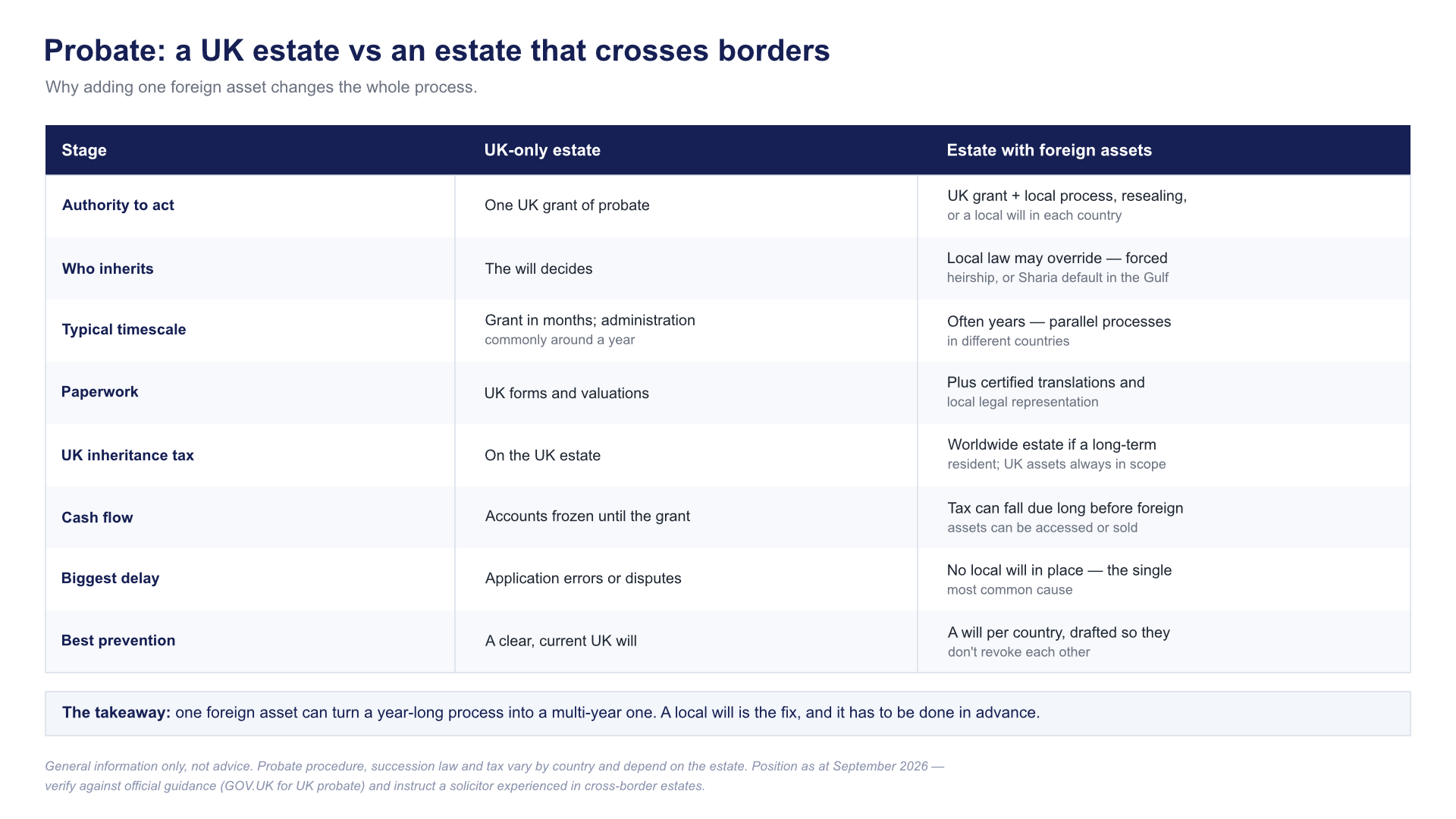
People often confuse two different timelines. Getting the grant in the UK usually takes a few months once the paperwork is correct. Fully administering an estate—valuing assets, settling tax, selling property, and distributing everything—often takes about a year. If there are foreign assets, both timelines can be much longer.
Why cross-border estates take so much longer
Here's where expat families get caught out.
A UK grant doesn't automatically work abroad
This is the single biggest misunderstanding. A UK grant of probate gives authority over UK assets. It doesn't automatically give your executors power over a French apartment, a Spanish bank account, or a Dubai property.
For overseas assets, you'll generally need one of the following:
A separate local probate process in that country, under its own rules and language; or
Resealing, a process where certain Commonwealth countries formally recognise a UK grant. This is quicker than starting from scratch, although only some countries offer this option; or
A local will already in place, which is usually the fastest route.
Each option takes time, requires local legal help, and often needs certified translations of documents. Managing two or three processes at once, in different languages and time zones, is why cross-border estates can take years to resolve.
Read our guide to international estate planning for expats to learn more.
Different countries have different rules, and sometimes even different heirs
Succession rules vary enormously, and your UK will may not be valid abroad.
Many civil-law countries (France, Spain, Italy and others) apply forced heirship, reserving fixed shares of an estate for children regardless of the will. Much of the Gulf applies Sharia-based succession by default.
The UAE point is worth stating plainly, because it surprises people.
In the absence of a valid, registered UAE will, Sharia succession principles have frequently been applied to the UAE assets of non-Muslim expatriates, regardless of their nationality or religion.
A surviving spouse who thought they would inherit the Dubai apartment outright may instead find it divided into fixed shares. Non-Muslims can avoid this by registering a will through the DIFC Wills Service Centre, the Abu Dhabi Judicial Department, or Dubai Courts, but they must do so in advance.
We cover the planning side of this in our article on wills and trusts for British expats.
Frozen accounts and stranded families
The main problem for families is cash flow. While probate continues in two countries, the deceased's accounts are usually frozen.
However, funeral costs, property maintenance abroad, and sometimes inheritance tax must be paid long before the estate can cover them. Families often have to pay these costs themselves and wait to be reimbursed.
For estates with an illiquid asset, such as a foreign property, that gap can last a very long time.
UK inheritance tax doesn't stop at the border
There’s an important imbalance: your executors may struggle to access your overseas assets, but HMRC may still include them for tax purposes.
Under the residence-based rules starting in April 2025, anyone who has lived in the UK for 10 out of the last 20 tax years will have their worldwide estate included in UK inheritance tax. This rule continues for a period even after leaving the UK. UK-based assets, especially property, are always included, no matter where you live.
So an estate can owe UK inheritance tax on a foreign property while being unable to access it for months. Our article on UK inheritance tax for expats explains the residence rules and the tail in detail.
What executors of an expat estate should do
If you're administering an estate with foreign assets:
Establish which assets sit in which country, and get a local valuation for each.
Find out whether a local will exists in each jurisdiction — it changes the route entirely.
Check whether resealing is available before commissioning a full local process.
Instruct local legal help early in each relevant country; delays compound.
Budget for translating and certifying UK documents.
Pay close attention to UK inheritance tax deadlines. Tax may be due before you can access the assets, so plan ahead for how you will pay it.
What you can do now, while planning
If you are reading this to help your family avoid these problems, instead of dealing with them right now:
Make a will in every country where you have significant assets, and make sure they do not cancel each other out.
If you have assets in the UAE and you are not Muslim, register a UAE will with DIFC, ADJD, or Dubai Courts.
Keep an up-to-date list of your assets by country, including account details and contacts. Executors can lose months just figuring out what assets exist.
Think about how these costs will be covered, so your family does not have to pay out of pocket while accounts are frozen.
See if joint ownership or trusts are right for any of your assets. However, be cautious with US-style "avoid probate" advice, as it does not always work well for UK or cross-border estates.
Probate is a process where a few hours of planning can save your family months of trouble. This is even more true for cross-border estates.
If you want help making sure your estate is organised so your family does not have to sort it out across several countries, speak to Holborn Assets.

Financial planning with Holborn?
Holborn can help you make way more money than you have now.
All information contained in this article was correct at the time of publication. This article is for informational purposes only and is not financial advice. For personal financial advice, always speak to a regulated professional.
Don’t just take our word for it...
We’re rated 4.8 out of 5 on Feefo, based on verified reviews from real client experiences
 4.8 / 5