Insights
Offshore Bonds vs International SIPPs vs ISAs: Where Should Expats Hold Their Money?
6th October 2026
What type of investment wrapper should you choose as an expat?
It’s not always easy to decide. Here’s a straightforward look at the three main options: the ISA, the international SIPP, and the offshore investment bond.
The important thing to know is that these options aren’t really in competition. Each serves a different purpose, has its own tax rules, and many expats with significant assets use more than one.
The real question isn’t which one is best. Instead, it’s about what each one does and when to use them.
The ISA: excellent, but frozen while you're away
For UK residents, the ISA is close to unbeatable: completely free of UK income tax and capital gains tax, no reporting, and total flexibility.
For expats, there’s one big issue: you can’t add money to an ISA while you’re not a UK resident. You can keep your existing ISA, and it will keep growing tax-free in the UK. Your allowance becomes active again as soon as you return to the UK, but while you’re living abroad, you can’t add new funds.
There’s another point many people overlook: your ISA is only free from UK tax, not foreign tax. If you move to a country that doesn’t recognise the ISA, your new home may tax the income and gains inside it. In the UAE and much of the Gulf, where there’s no personal income tax, the ISA usually stays tax-free. In the US, France, or Spain, it often doesn’t.
Verdict: keep your ISA and don’t rush to close it. If you return to the UK, it will start working for you again. Just remember, you can’t use it for new investments while you’re overseas.
For a more detailed breakdown, our article covers what happens to your ISA when you move abroad.
The international SIPP: the pension wrapper that travels
An international SIPP is a UK-registered personal pension designed for people living outside the UK. It keeps your pension under UK rules while fitting the needs of life abroad.
What it does well
It lets you combine different UK pension pots in one place. You can usually hold more than one currency, so you don’t have to keep everything in sterling. Growth inside the wrapper is free from UK income and capital gains tax, and you still get the 25% tax-free lump sum. With the right double-tax treaty and an HMRC "NT" (no tax) code, you might be able to get your income paid without tax being taken off first.
The trade-offs
Since it’s a pension, your money is locked away until at least age 55 (rising to 57 in April 2028). When you take money out, it’s taxed as income, and your country of tax residence at that time matters. Also, from April 2027, most unused pension funds will be subject to UK inheritance tax, which reduces the use of pensions for estate planning.
Verdict: For most expats with UK pensions, this is usually the best place for your money. It keeps UK regulatory protection, avoids the 25% overseas transfer charge, and helps with currency and consolidation issues. It may seem like the safe and sensible choice, and that’s often a good thing.
→ QROPS vs SIPP vs leaving it in the UK · the transfer charges that catch expats out
The offshore bond: flexible, useful — and the one to scrutinise
Offshore investment bonds, also known as international portfolio bonds, are life-insurance wrappers that hold your investments. They’re usually issued from the Isle of Man, Dublin, or Luxembourg.
What they genuinely offer:
Gross roll-up: Investments grow without annual UK income or capital gains tax inside the wrapper, so returns compound without the yearly drag.
The 5% withdrawal allowance: You can take up to 5% of your original investment each policy year, for 20 years, without an immediate UK tax charge — and unused allowance rolls forward.
Time apportionment relief: This is the genuinely valuable one for expats. When a gain becomes taxable, this relief limits the UK-taxable portion to the time you were a UK resident. If you held a bond while living abroad for ten years and then returned, you could exclude most of the gain from UK tax.
Top-slicing relief: Which stops one large gain from pushing you into a higher band.
Portability: With no annual UK reporting while you hold it.
The critical misunderstanding
The 5% allowance is tax-deferred, not tax-free. Withdrawals count when you calculate the final gain. If someone tells you it’s “5% a year tax-free income,” they are either mistaken or not looking out for your best interests.
The real problem: charges
Offshore bonds are often linked to expat mis-selling, mainly because of commissions. Charges can add up in hard-to-spot ways: an establishment charge, ongoing administration fees, fund charges underneath, and, most importantly, early-exit penalties that can lock you in for five to ten years. A bond with high layered charges can quietly eat away more value each year than the tax it defers. This isn’t a reason to avoid the product, but it is a reason to check the charges carefully.
One more caveat
The UK reliefs above are UK rules. If you're tax resident elsewhere, your host country may tax the bond on completely different principles, and gross roll-up may mean nothing locally.
Verdict: Offshore bonds can be genuinely useful in certain situations, especially for a large lump sum held by someone planning to return to the UK and use time apportionment relief. They are often not suitable for people who would be better off with a simple, low-cost platform.
Learn more: The investment traps that catch British expats out
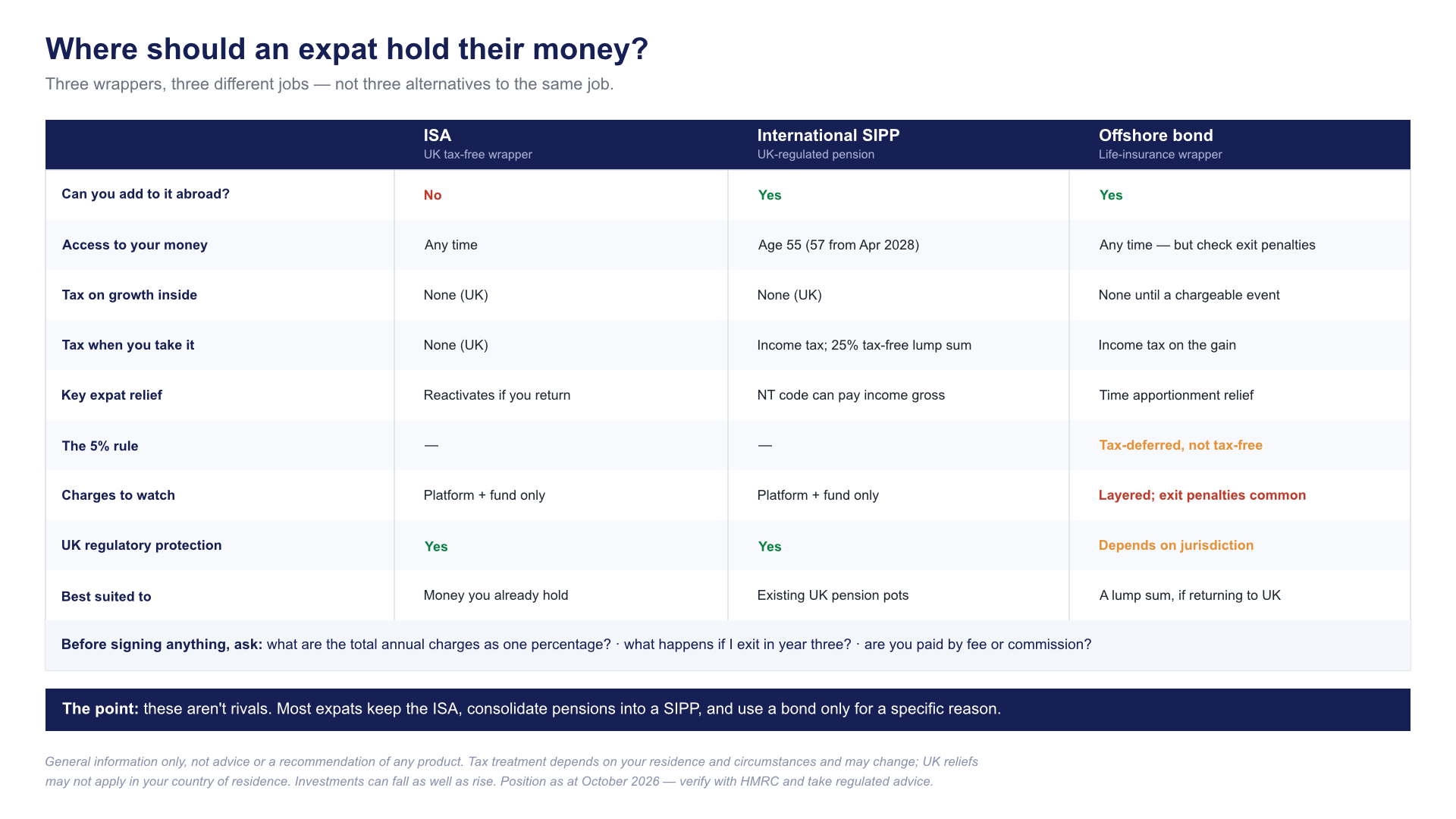
So how should you think about the order?
Rather than picking a winner, most expats are better served by a sequence:
Start by sorting out the pensions you already have: Scattered UK pots, poor investments, or money stuck in sterling you don’t need are usually the biggest and easiest wins. The international SIPP is designed to help with this.
Don’t touch your ISA: It isn’t causing any problems, it’s growing tax-free, and it becomes valuable again as soon as you’re a UK resident.
Next, think about where to put new money: A low-cost international investment platform is often the simplest choice and should be the standard you compare everything else to.
Only consider a bond if you have a specific reason: A large lump sum, an expected return to the UK where time apportionment relief would help, or a particular estate-planning need. Make sure you have seen all the charges in writing first.
The three questions to ask before you sign anything
Whatever wrapper is proposed, these cut through most of the noise:
"What are the total annual charges, as one percentage?" Not a list of components, but one number in writing.
"What happens if I want out in year three?" Exit penalties are where the real damage is done.
"How are you paid: a fee from me, or commission from this product?" The answer usually explains the recommendation.
A good adviser will answer all three without hesitation. Anyone who deflects has told you what you need to know.
The right structure depends on your assets, your timeline, where you’ll be tax resident when you take the money, and whether you plan to return to the UK. This is a personal decision, so it’s worth getting regulated, fee-transparent advice instead of relying on a brochure.
If you'd like an impartial review of how your investments are structured, speak to Holborn Assets.
All information contained in this article was correct at the time of publication. This article is for informational purposes only and is not financial advice. For personal financial advice, always speak to a regulated professional.
Don’t just take our word for it...
We’re rated ‘Excellent’ on Trustpilot, based on thousands of verified reviews from real client experiences