Insights
QROPS vs SIPP vs Leaving It in the UK: Which Is Right for Your Pension in 2026?
9th July 2026
If you have a UK pension and now live abroad, you may have heard that transferring it overseas is the best choice. That was often true ten years ago, but things have changed. Now, it's important to find the option that suits your situation.
The rules for expat pensions have changed a lot in the last two years. These changes happened quietly but have real financial consequences.
The October 2024 Budget closed a route thousands of expats had relied on, and an allowance introduced earlier that year means a hefty tax charge can now catch pots that were once well within safe limits.
A lot of the advice you find online, and even some given overseas, reflects a world that no longer exists.
As an expat, you have three real options for your UK pension: leave it where it is, transfer it, or take another route. The right one depends entirely on your circumstances. Here's how they compare in 2026.
First, the honest answer: you may not need to do anything
You might think that moving abroad means your pension must move too, but that's not the case. If you leave your UK pension where it is, it stays valid, keeps paying out, and remains under UK regulation. As you'll see, this can be more valuable than it first appears.
The three options are:
Leave your pension in the UK
Move it to an international SIPP
Transfer it to a QROPS
A fourth, more specialist option is a QNUPS. This suits only a small group of people and is not covered in this article. For a full comparison of SIPPs, QROPS, and QNUPS, see our detailed breakdown. Before weighing them up, it's also worth understanding how the pension transfer process works more broadly.
Here, we're focused on the decision most expats actually face. Let's take each in turn.
Option 1: Leave it in the UK
The simplest option is often overlooked because it seems so straightforward. If your pension is with a good UK provider, you can usually leave it there, let it grow, and draw income from it in retirement, no matter where you live.
The main benefits are protection and lower costs. The Financial Conduct Authority (FCA) regulates UK pensions, and most UK-authorised schemes are covered by the FCA's Scheme. This safety net is not available in the same way if your money is in an overseas scheme. UK pensions also usually cost less to run than offshore options, though fees can vary.
The downside is that older UK pensions, especially workplace schemes from years ago, can be inflexible. Some don't allow modern drawdown, some are hard to manage from another time zone, and some offer only a limited range of outdated funds.
This is where a popular middle option helps: you can combine older pensions into a single, modern UK plan, often a SIPP (more on that below), while keeping your pension within the UK system.
You gain better investment choices and flexible access while staying FCA-regulated and usually paying lower charges. For many expats, this is all their pension really needs.
Consolidating isn't automatically right, though. An older scheme may carry guarantees or benefits worth keeping, so check before you combine anything.
Plan carefully for how your pension income will be taxed. The tax you pay depends on any double taxation agreement between the UK and your country of residence. These rules vary widely by country, so personalised, cross-border tax advice is important before you start taking money.
Option 2: The international SIPP
A SIPP — Self-Invested Personal Pension — is a UK pension offering a wide choice of investments and flexible access in retirement.
An international SIPP is simply a version designed for people living outside the UK: it can accept non-UK residents and is usually set up to handle multiple currencies and overseas administration.
The key thing to know is that an international SIPP remains in the UK. It is UK-based and FCA-regulated, and moving your UK pensions into one does not count as an overseas transfer. This means the transfer charges discussed in the next section do not apply. That is what makes it so appealing in 2026.
For most expats, an international SIPP now delivers exactly what people once moved abroad to get:
Flexibility: Flexible drawdown, so you control how and when you take an income.
Investment choice: A broad range of funds and, often, the ability to manage currency exposure.
Consolidation: Several old pensions in one plan that you can actually see and manage from abroad.
Protection: You stay within the UK's regulatory and compensation framework.
A SIPP is not the right answer for everyone. With a SIPP, you make the investment decisions and take on the related risks. The value of your pension can go up or down, and your results depend on your choices. Fees and investment quality also vary a lot between providers, and taking out too much can use up your pot in retirement.
So while an international SIPP is, for many expats, a strong starting point and a sensible benchmark for measuring any QROPS proposal, it still warrants proper advice tailored to your circumstances.
Option 3: QROPS
A QROPS — Qualifying Recognised Overseas Pension Scheme — is an overseas scheme that HMRC recognises as eligible to receive UK pension transfers.
For years, it was the headline expat pension product. It still has a place, but a far narrower one than the 2010s marketing implied.
A QROPS can be a good choice in the right situation. Expats can hold their pension in a scheme that matches their country of residence, possibly in the local currency, and it can offer estate-planning flexibility.
How achievable that is varies enormously by country. For example, in Australia, transfers are limited to savers aged 55 and over and to a small number of qualifying funds. But you should consider two important things first.
First, "recognised" is not a stamp of quality. HMRC publishes a list of recognised overseas schemes, but being on it doesn't confirm a scheme's full QROPS status or that it's a sensible home for your money. Transferring to a scheme that turns out not to be a genuine QROPS can trigger tax charges of 40% or more, so due diligence is essential.
Second, and this is the major change, the exclusions that once allowed many European expats to transfer QROPS without charges have been tightened.
Since the October 2024 Budget, the exemption allowing charge-free transfers to a scheme elsewhere in the EEA or Gibraltar has been removed.
Today, a 25% Overseas Transfer Charge applies to a QROPS transfer unless you meet a specific exclusion. The main one is that the QROPS must be based in the country where you're tax resident (a few narrow employer- and international-organisation exclusions also exist).
Transfers are then tested against your Overseas Transfer Allowance — normally £1,073,100 — with anything above it taxed at 25%. And because that allowance is reduced by any pension benefits you've already taken, the charge can bite even on pots below the headline figure.
The obligations last, too. HMRC reporting requirements can follow your money for up to ten years, and a five-year residence test means a charge you thought you had avoided can still apply if your situation changes. We break these charges down in full, including the traps that trigger them by accident, in Transferring a UK Pension Overseas: the tax charges that catch expats out.
None of this means QROPS is a bad choice. For expats who are settled long-term in a country with a suitable local scheme and plan to stay, it can still be the right option. However, this group is much smaller than it used to be.
Side by side: How the three options compare
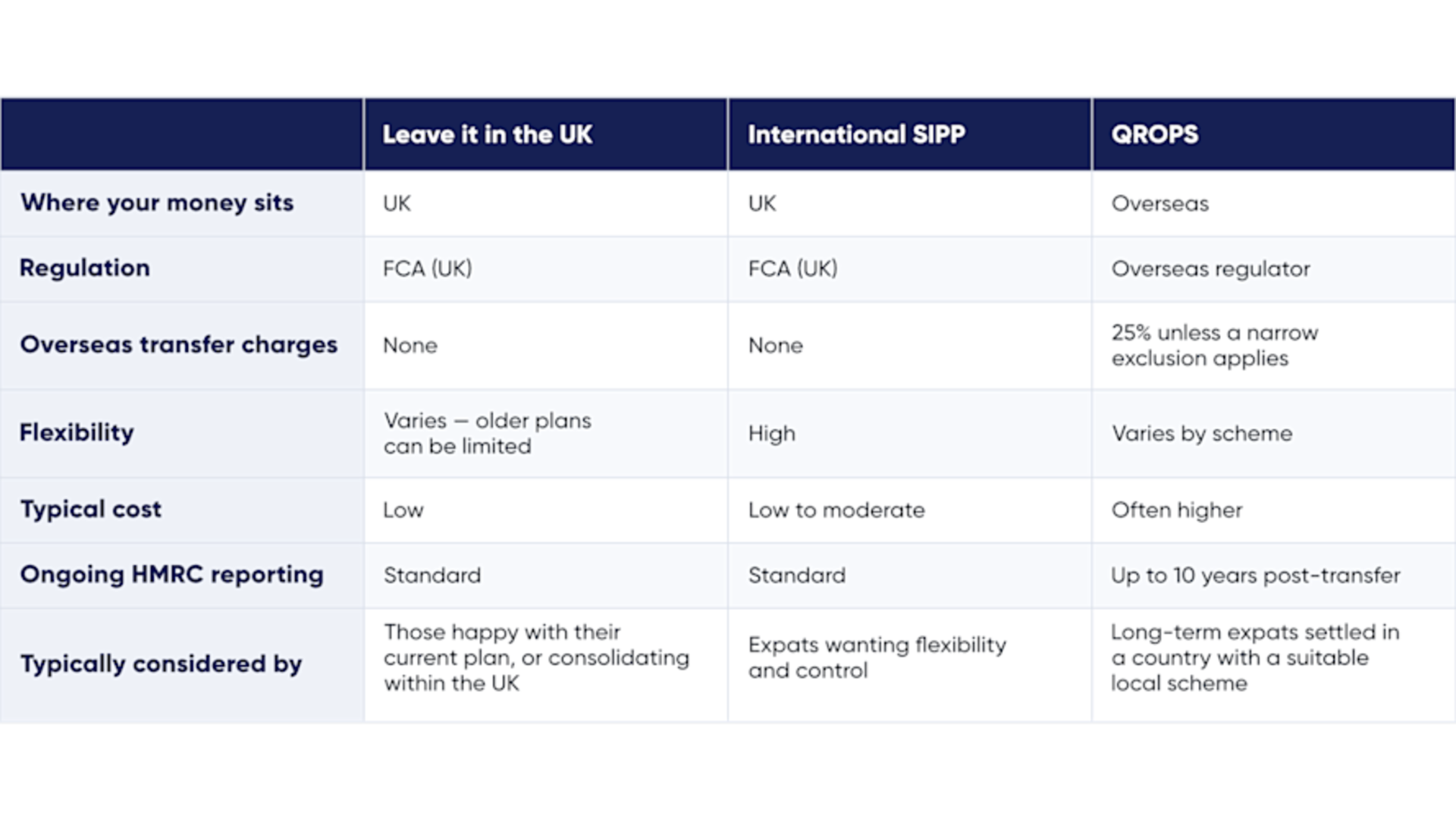
This table is a general summary to help you understand your options. It is not a personal recommendation, and the value of pension investments can go down as well as up. Figures and rules are current as of July 2026 and may change. Always check your own situation with a regulated adviser.
A reality check for expats in the UAE and wider Gulf
If you are reading this from Dubai, Abu Dhabi, Doha, or anywhere else in the Gulf, pay special attention. Advice meant for a general UK audience can sometimes be misleading for your situation.
The most valuable QROPS exclusion — the one that avoids the 25% charge — requires the scheme to be based in the country where you're tax resident. For an expat in Portugal, that can be achievable. For an expat in the UAE, it generally isn't, because there's no domestic QROPS market to transfer into. In practice, a QROPS transfer from the Gulf would often trigger the 25% charge rather than avoid it.
This is why the international SIPP has become the main choice for many expats we advise in the region. It offers the flexibility, investment options, and consolidation people want, keeps your money under UK regulation, and prevents you from losing a quarter of your pot to transfer charges.
Which option is right for your pension in 2026?
You don't need to memorise the rules to make a good decision. You need to answer a few honest questions, then have someone qualified check the details to assess your specific position.
Are you settled, or still mobile?
If you are not sure where you will retire long-term, keeping your pension in the flexible, UK-regulated system, either by leaving it in place or using an international SIPP, keeps your options open. QROPS works best for those who are certain about their plans, but it can be costly if your situation changes.
What do you actually want that you don't already have?
If the honest answer is "more flexibility and a clearer view of my pensions," an international SIPP or a UK consolidation usually gets you there without an overseas transfer.
How large is the pot, and have you taken any benefits yet?
Larger pots — and anyone who has already drawn tax-free cash or income — need the Overseas Transfer Allowance checked carefully before a transfer is even considered.
Is any of it a final salary pension?
If so, treat that pot completely separately: transferring out of a defined benefit scheme means giving up guarantees that are usually valuable, and regulated advice is required by law above £30,000.
Who's advising you, and how are they paid?
Be wary of anyone recommending an overseas transfer without first showing why a UK-based option wouldn't do the same job more cheaply. That comparison should open the conversation, not close it.
The good news is that for most expats in 2026, the best choice is also the simplest and most affordable: keep your pension in the UK system, in a plan flexible enough to work wherever you live. QROPS is still a valid option, but it is now a specialist tool for specific situations.
Get your pension reviewed
The worst outcome is not picking the 'wrong' option, but making a transfer you cannot undo and paying a charge you could have avoided, all because of outdated advice.
Before you move anything, have your pensions reviewed by an adviser who will weigh all three options against your actual circumstances and country of residence.
Book a pension review with Holborn Assets.
All information contained in this article was correct at the time of publication. This article is for informational purposes only and is not financial advice. For personal financial advice, always speak to a regulated professional.
Don’t just take our word for it...
We’re rated 4.8 out of 5 on Feefo, based on verified reviews from real client experiences
 4.8 / 5