Insights
Your ISA and Moving Abroad: The Rules on Leaving, Living Abroad, and Returning
21st August 2026
With the 2026 Autumn Budget coming up, savers are preparing for changes. One change is already confirmed: from April 2027, the amount you can put into a cash ISA will be reduced.
Many people have wrongly reported that ‘the ISA allowance is being slashed.’ For those living between two countries, this has caused confusion.
Let’s clear this up and look at a bigger question: what really happens to your ISA when you leave the UK? ISAs work differently once you move abroad, and it’s easy to make mistakes.
What's actually changing in 2027? (It's not what the headlines say)
Your total ISA allowance is not being reduced. It remains at £20,000 a year. The change is in how much of that £20,000 you can keep in cash:
Starting 6 April 2027, if you are under 65, the cash ISA limit drops from £20,000 to £12,000 a year. You can still use the remaining £8,000, but it must go into a stocks and shares ISA or another investment-type ISA, not cash.
If you are 65 or older, you are exempt and can keep the full £20,000 cash allowance.
This change only affects new contributions made after that date. Any money already in your cash ISA is unaffected and remains tax-free.
To prevent people from avoiding the cap, anyone under 65 can't transfer money from a stocks and shares ISA into a cash ISA. Transfers from cash ISAs to stocks and shares ISAs are still allowed.
In summary, you can still protect £20,000 a year from tax. If you are under 65, you will need to invest at least £8,000 of it instead of keeping it all in cash.
This change is much less worrying than ‘the allowance is being cut’. Also, tax on savings interest outside an ISA will go up from April 2027, making the ISA wrapper even more valuable. It’s a good reason to use your ISA wisely, not to give up on it.
While you're abroad: you can't pay in
Here's the rule that catches people out, and it has nothing to do with 2027: you can only contribute to an ISA if you're a UK resident.
As soon as you are no longer a UK tax resident, you cannot add new money to your ISA for any tax year in which you are non-resident. You must also inform your ISA provider once you stop being a resident.
The Statutory Residence Test decides if you are a UK resident. We explain this in our guide, Am I still a UK tax resident? It is worth reading, as residency is not just about where you live.
The good news is you do not lose what you have already saved. You can keep your existing ISA, and it will remain protected from UK tax and can keep growing. You cannot add more money while you are abroad.
A small exception applies to Crown employees posted overseas, such as diplomats and armed forces personnel, and their spouses or civil partners. They can keep paying into their ISAs.
While most expats can’t contribute to an ISA, other investment wrappers are available, such as offshore bonds and international SIPPs.
The trap most people miss: ‘UK-tax-free’ isn't ‘tax-free’
This is the main issue, and it often catches expats off guard.
An ISA is free from UK tax, but that protection does not move with you. Many countries do not recognise the ISA wrapper and will tax the interest, dividends, and gains inside it as if it were a regular account.
So an ISA you have kept tax-free in Britain could become taxable as soon as you live in a country that does not recognise the wrapper. How and whether your ISA is taxed depends on the country you move to and its tax treaty with the UK. You should check this with a qualified tax adviser in your new country before you go. Assuming your ISA stays tax-free everywhere can be a costly mistake.
How different countries treat it varies a lot. In places with no personal income tax, like the UAE and much of the Gulf, your ISA will not be taxed locally at all. Its tax-free status survives the move (you still cannot add to it, but you also aren't taxed on it).
Many popular destinations are less generous. The United States, France, Spain, and others usually tax the income and gains inside an ISA as regular investment returns. Some countries also treat pooled funds in an ISA especially harshly.
The wrapper that saves you tax at home can be worthless abroad, or even create extra reporting problems. The only way to know is to check the rules in your new country.
When you come back: your allowance reactivates
Things change when you move back to the UK. Once you are a UK tax resident again, you can start paying into an ISA again. You'll have the full £20,000 annual allowance in the tax year you return.
This is where the 2027 change really matters for expats. If you return and are under 65, you will face the same £12,000 cash cap as everyone else from April 2027. If you plan to come back and want to rebuild your cash savings, the 2026/27 tax year (up to 5 April 2027) is the last full year when you can put the whole £20,000 into cash.
But this is a reason to plan, not to panic. For most people, deciding whether to keep £20,000 in cash or split it between cash and investments is a sensible portfolio choice, not a race against a deadline. Rushing money into cash just to beat the new limit can be a mistake.
What to do
Think of your ISA as something to manage throughout your whole journey, not just while you’re in the UK:
Before you leave: Use your allowance while you still can, and remember that you won’t be able to contribute once you’re non-resident. Let your provider know when you move.
While you’re abroad: Find out how your new country taxes your ISA. Don’t assume it stays tax-free, and consider whether keeping it is still the best option.
When you return: Your ability to contribute returns with your residence; build the 2027 cash rules into your rebuild, rather than reacting to a headline.
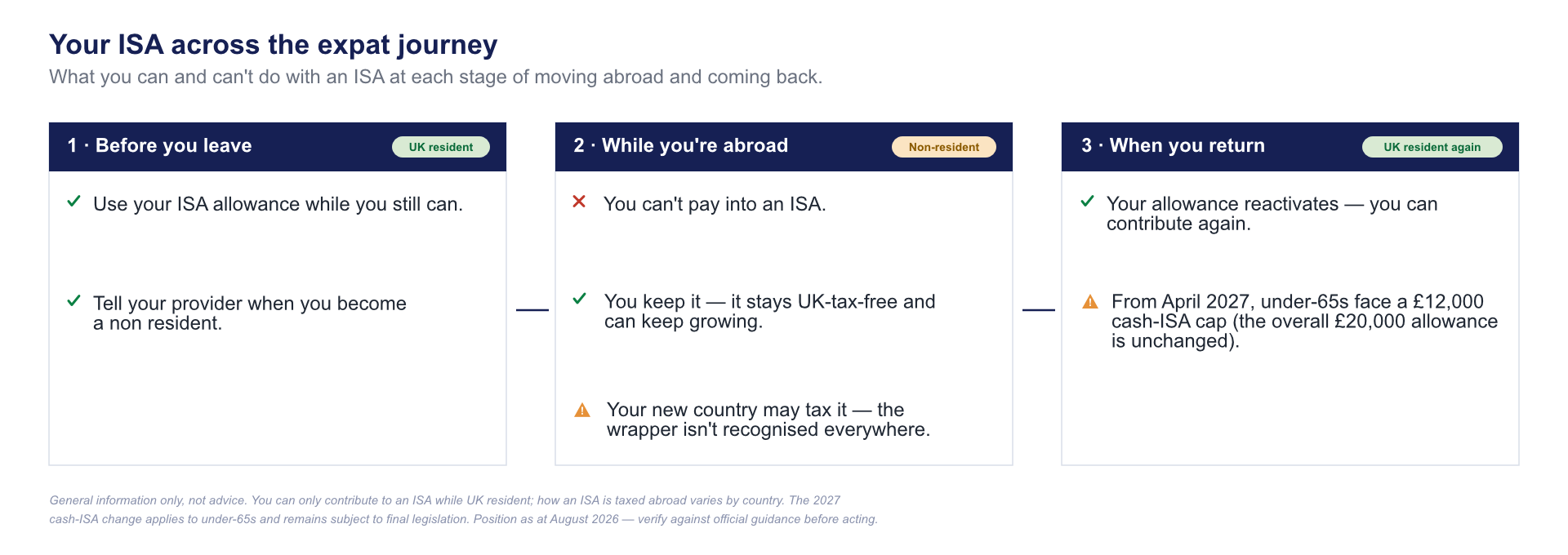
At every stage, your ISA depends on your residence status, your new country’s tax rules, and your overall plan. It’s worth getting advice rather than relying on assumptions, especially with cross-border tax.
If you'd like help fitting your ISA into a move abroad or a return to the UK, speak to Holborn Assets.
All information contained in this article was correct at the time of publication. This article is for informational purposes only and is not financial advice. For personal financial advice, always speak to a regulated professional.
Don’t just take our word for it...
We’re rated 4.8 out of 5 on Feefo, based on verified reviews from real client experiences
 4.8 / 5