Most people move to the UAE for one main reason: the earning potential.
You keep your entire salary, which lets you build wealth and transform your financial life. However, this is often where most people stop planning their finances, and that can be a problem.
Earning a tax-free salary is easy. What matters is how you manage your money and what the UK still expects. These choices will decide if you build real wealth or waste your earning potential.
This guide brings it all together: what the UAE taxes and doesn't, the often-overlooked pension gap, the UK obligations that still apply, and the costs that can surprise families. Think of it as your map. Each section links to a more detailed guide if you want to learn more.
What the UAE taxes — and what it doesn't
The headline holds. The UAE has no personal income tax in 2026 for residents or expats, regardless of nationality.
Salaries, wages, bonuses, investment income, dividends, interest and capital gains are all untaxed at the individual level. There's no inheritance tax, wealth tax, or social security contributions for expatriates. Your gross salary really is your net salary.
On an £80,000 salary, you take home about £23,000 more each year than you would in London. However, higher living costs in the UAE can reduce some of these gains.
What the UAE does tax:
The UAE has a 9% corporate tax on business profits above AED 375,000, levied by the UAE Federal Tax Authority (FTA), which started in June 2023. Importantly, this does not apply to employment income, so it does not affect your salary. However, freelancers and sole traders earning above the threshold may need to pay this tax.
A 15% minimum top-up rate will apply to very large multinationals (with global revenue above €750m) starting January 2025. This affects employers, not your payslip.
VAT at 5% on most goods and services.
Excise taxes on tobacco, energy and sugary drinks, plus various municipal fees.
So, while "tax-free" is true for your income, it can be misleading for your overall life in the UAE. You still pay VAT and fees on almost everything you buy.
One signal worth watching
Oman has announced a personal income tax taking effect from January 2028 — the first in the GCC.
This does not change anything in the UAE right now, and no personal income tax has been announced or is expected here. Still, it’s wise not to assume Gulf income will always be untaxed. Make plans based on the current rules, but remember things can change.
The gap nobody warns you about: there is no pension here
This is the single most important thing in this guide.
The UAE has no state pension or workplace pension system for expatriates. Nothing accrues on your behalf. No employer contribution is quietly building in the background, no auto-enrolment, and no state provision.
Instead, under UAE Labour Law, you receive an end-of-service gratuity. This lump sum is based on 21 days of your basic salary per year for the first five years, then 30 days per year after that, paid when you leave. It is a real benefit, but it is not a pension, and treating it as one is a costly mistake. Here are two reasons why:
It is calculated only on your basic salary, not your total package. For example, if your AED 20,000 package includes AED 12,000 as basic salary, your gratuity is based on the 12,000. This often means people get about half of what they expect.
It's a finite lump sum, not an income for life. Ten years of service on an AED 12,000 basic salary yields around AED 102,000. That is not a retirement.
New funded alternatives are now available, such as DIFC's DEWS scheme, ADGM's arrangements, and a UAE-wide voluntary savings scheme. These are usually better for employees because the money is invested and protected, not just a promise. If your employer offers one, make sure you understand it.
But the main lesson remains: in the UAE, you are fully responsible for your retirement. A tax-free salary is a benefit, but the lack of a pension system is the downside. Every year you don't save part of your salary for the long term is a year you haven't prepared for retirement.
→ Full detail: UAE end-of-service gratuity explained
Your UK ties don't disappear when you land
Many people think that moving to Dubai ends your connection with the UK tax system. It doesn't end; it just changes, and some ties still follow you.
Your UK tax residence is decided by a test, not by your address
The Statutory Residence Test checks how many days you spend in the UK and your connections to it. You can live and work in Dubai and still be a UK tax resident if you keep enough links, such as a family home, regular visits, or work days. Getting this wrong can be costly.
→ Am I still a UK tax resident?
Your ISAs freeze
You can keep your existing ISA, and it remains free of UK tax, but you cannot add more money while you are non-resident, and you must inform your provider. The good news for UAE residents is that, since there is no local income tax, the UAE will not tax it either. This means its tax-free status continues, unlike in countries that do not recognise the ISA wrapper. While expats often can’t contribute to an ISA, other investment wrapper options are available.
Your State Pension will be frozen
The UAE is not on the list of countries where the UK increases the State Pension. Whatever rate you receive when you start, you keep for life, with no yearly increases. Over a long retirement, this loss adds up, so you will need to rely more on your own savings. The same applies in Australia, Canada and New Zealand — the freeze is about which country you retire to, not where you worked.
→ The frozen State Pension trap
UK inheritance tax may still reach your estate
Since April 2025, IHT is based on residence instead of domicile. If you have been a UK resident for 10 out of the last 20 tax years, you are considered a "long-term resident," and your worldwide estate is included. This rule continues for years after you leave. Any UK property you own is always included, no matter where you live.
→UK inheritance tax for expats
Your UK pensions still exist and still need decisions
It is often wise to leave your UK pensions where they are. Moving them overseas can lead to a 25% charge. Take your time, and don't let anyone pressure you.
→ QROPS vs SIPP vs leaving it in the UK and the transfer charges that catch expats out
Currency: your money is really in dollars
The dirham is pegged to the US dollar, and most UAE expats underestimate the consequence. Your currency risk isn't really about the dirham; it is a pound-versus-dollar story.
When sterling strengthens against the dollar, your dirham savings buy fewer pounds; when it weakens, they buy more. Over the past decade, that swing has been dramatic: £10,000 converted at the wrong moment in 2022 was worth roughly AED 15,000 less than the same sum in 2016.
For anyone planning to bring savings home, fund a UK mortgage, or pay UK school fees from a dirham salary, that exposure is real money and deserves planning, not luck.
→ The cost of moving money · managing currency exposure · what the pound has done this decade
The costs that catch families out
School fees are usually the biggest line in the budget
Expat education costs are often the biggest expense for many families, even bigger than rent.
Dubai international schools range from about AED 5,000 a year at the budget end to AED 120,000 to 130,000 or more at top British and IB schools. At a premium school, the total cost, including transport, exams, and tutoring, can reach about AED 136,000 per child. With fee inflation of 3 to 5% a year, planning for today’s fees will not be enough.
→ School fees without the shock
Healthcare is excellent but has an age curve
Cover is mandatory and usually provided by your employer during your working years, so it is not an issue until it stops.
There is no public system for expats to rely on, and private premiums rise sharply with age. Retirees without employer cover face higher costs. Plan for these increases, not just today’s premium.
→ Expat healthcare: the best and worst countries
Property, both here and at home
Dubai property is a real option, with no local personal tax on rental income. UK property, if you keep it, is a different story.
The Non-Resident Landlord Scheme, stacked stamp duty surcharges for non-residents, capital gains tax with a 60-day reporting deadline, and UK IHT regardless of where you live.
→ Funding a UK property from abroad
Your estate: the UAE will needs doing
This is what surprises most British families about estate planning.
If there is no valid, registered UAE will, Sharia succession principles are often applied to the UAE assets of non-Muslim expatriates, regardless of nationality or religion. A surviving spouse who thought they would inherit the Dubai apartment outright may instead find it distributed in fixed shares.
Non-Muslims can opt out by registering a will through the DIFC Wills Service Centre, the Abu Dhabi Judicial Department, or Dubai Courts. This will sits alongside your UK will rather than replacing it, and covers your UAE assets. If you own property here, have a business, or have young children and want to choose guardians, this is almost essential.
→ Wills and trusts for British expats · probate for expats
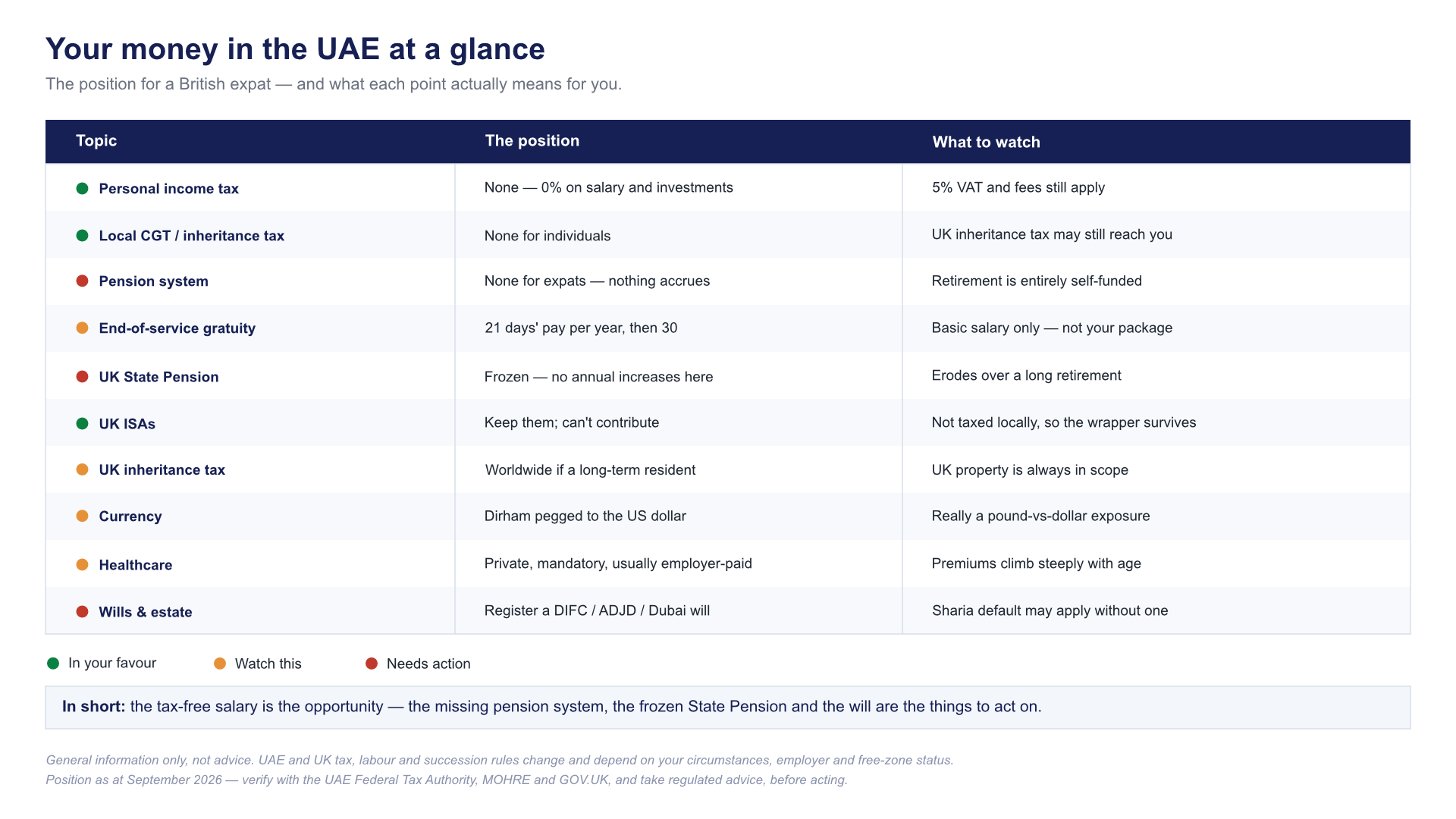
Summary: your money in the UAE
Here is a summary of everything mentioned in this guide and what it means for your finances as a British expat in the UAE.
The exit: plan it before you need it
Most UAE postings end eventually. Like leaving the UK, moving home benefits more from careful planning than almost any other financial decision.
The timing of your return determines your UK tax position. If you have been away ten years or more, you may qualify for four tax years of relief on foreign income and gains. Your gratuity arrives as a lump sum that needs a destination, and the currency conversion on years of savings happens all at once.
→ Moving back to the UK: the checklist expats forget
The UAE money checklist
Treat your tax-free salary as a time-limited opportunity. You won't build a pension, so turn some of it into long-term savings, on purpose and every month.
Find out your actual gratuity amount by looking at the basic salary listed in your contract, not the total package.
Check your UK residence status using the Statutory Residence Test, and keep records to prove it.
If you own assets in the UAE, register a will through DIFC, ADJD, or Dubai Courts.
Plan ahead for currency conversions, especially for large amounts. Remember, you are exposed to changes between the pound and the dollar.
Build the fees pot early if you have children, and price in 3–5% annual inflation.
Review your National Insurance record for gaps, and note that your State Pension will not increase while you are here.
Review your UK pensions, and be cautious if someone encourages you to transfer them overseas.
Understand your IHT exposure, particularly if you still own UK property.
Start planning your exit well in advance, rather than waiting until your last month.
The UAE gives British expats something rare: the chance to save a large part of a good salary. The people who leave wealthy are rarely the highest earners. They are the ones who saw the tax-free years as a limited window and made the most of them.
If you'd like help turning your UAE years into a plan that works wherever you end up, speak to Holborn Assets.
All information contained in this article was correct at the time of publication. This article is for informational purposes only and is not financial advice. For personal financial advice, always speak to a regulated professional.
Don’t just take our word for it...
We’re rated 4.8 out of 5 on Feefo, based on verified reviews from real client experiences
 4.8 / 5