Insights
UK Inheritance Tax for Expats: Why Leaving Britain Doesn't Mean Leaving IHT Behind
22nd July 2026
There's a comforting assumption a lot of British expats carry with them: "I've left the UK, so I don’t need to worry about UK inheritance tax now."
This belief is understandable. However, for many people, it’s wrong — and in April 2025 the rules that decide it were rewritten from the ground up.
This is one of the biggest changes to inheritance tax in a century, and it affects people in different ways. Some expats who thought they had escaped UK inheritance tax are still affected. Others, who believed they were stuck with it forever, can now avoid it.
The difference comes down to a single word that used to govern all of this — and no longer does.
Goodbye domicile, hello residence
For over a hundred years, whether the UK could tax your estate depended on your domicile, a complex legal idea of where your permanent home "really" was.
Domicile was difficult to change. You could live abroad for decades and still be treated as UK-domiciled, which meant your worldwide estate was exposed to UK inheritance tax. It was genuinely hard to lose UK domicile status.
From 6 April 2025, that has changed. Inheritance tax is now based on residence, which is concrete, measurable, and much easier to plan around. The question is no longer "where is your soul domiciled?" but instead, "how many of the last 20 years have you actually been a UK resident?"
For expats, this is a major, mostly positive change because residence is something you can control. Still, an estate with assets in different countries can be complex. Our article on probate for expats explains what happens to your estate when it crosses borders.
The 10-year rule: are you a "long-term resident"?
The new system introduces a status called the long-term resident. You become one once you've been a UK tax resident for at least 10 of the previous 20 tax years.
If you cross that threshold, your entire worldwide estate, including investments, cash wherever it is, and property, falls within UK inheritance tax. The tax is charged at 40% above your available allowances.
If you fall below it, only your UK assets are exposed.
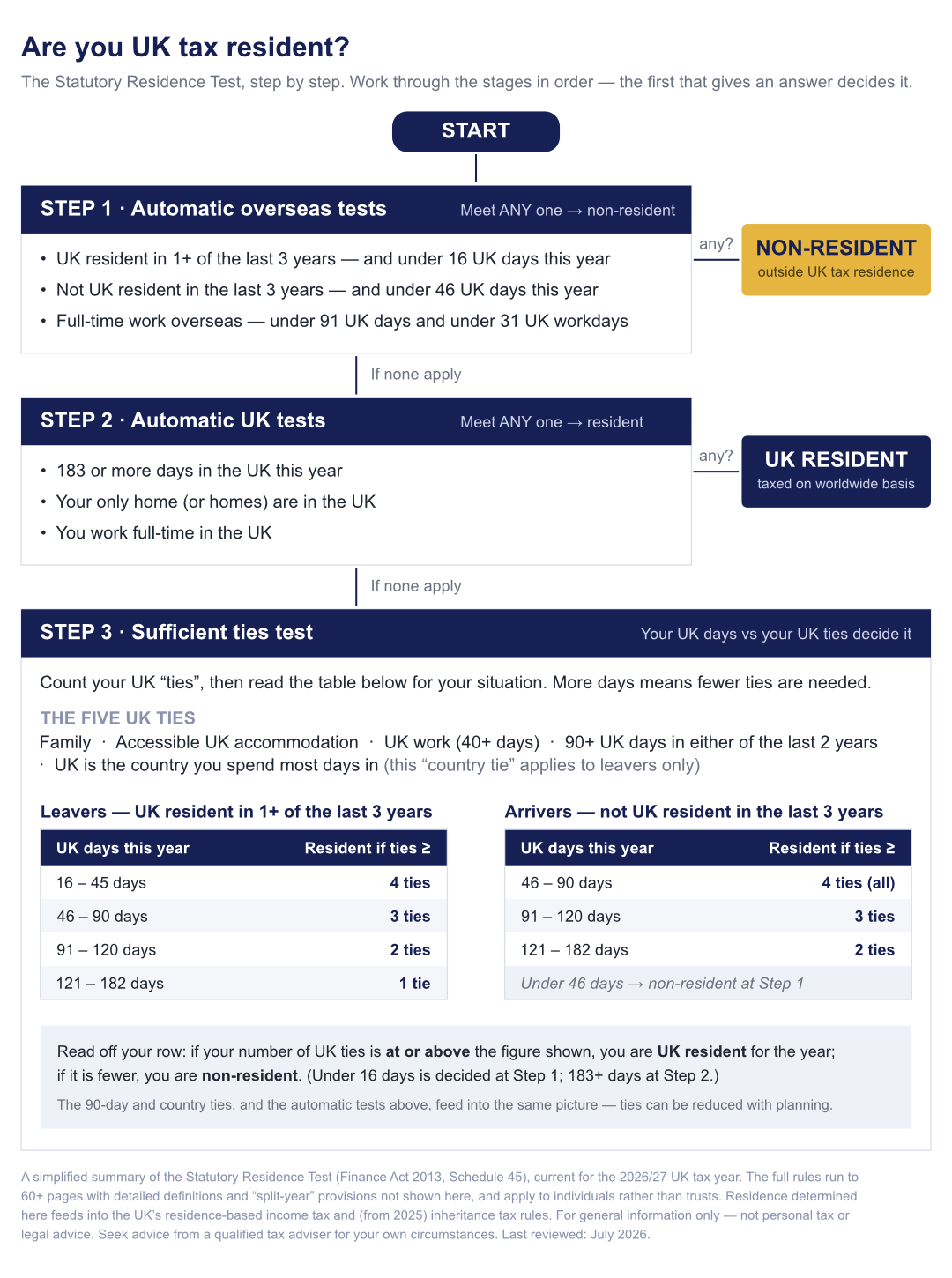
Two things are worth noting right away. First, the Statutory Residence Test determines whether you were "resident" in any given year. This is the same day-counting and ties test used for income tax, so it is a matter of record, not interpretation. Second, this new 10-year threshold is stricter than the old regime, which used a 15-year test. More people now enter the inheritance tax net, and they enter it faster.
Not sure which years count? The flowchart below walks through how the Statutory Residence Test decides it.
The part expats miss: UK assets never leave
Here is the first myth to clear up. Even if you are not a long-term resident, one category of your wealth always stays inside UK inheritance tax: assets located in the UK.
The most obvious example is a UK property. If you have kept the family home, a buy-to-let, or any other UK real estate, its value is still subject to UK inheritance tax no matter where you live, how long you have been away, or what your residence history is.
The same rule applies to other assets located in the UK. Saying "I left years ago" does not protect the parts of your estate that are still physically in Britain.
The good news: how expats can genuinely fall out of scope
Now for the myth in the other direction: the belief that UK inheritance tax follows you forever.
Under the new rules, it does not. If you stop being a long-term resident, your non-UK assets fall entirely outside the UK inheritance tax net. However, and this is the detail that catches people out, it does not happen the moment you leave the UK.
When a long-term resident leaves the UK, they remain within the inheritance tax net on their worldwide estate for a run-off period called the "tail". The length of the tail depends on how long you were resident in the first place:
If you were a UK resident for 10 to 13 of the previous 20 years, the tail is three years.
For each additional year of residence beyond that, the tail grows by one year.
At the top end, someone who was a UK resident for 20 years or more carries a ten-year tail.
So a professional who spent 12 years in the UK and then moved to Dubai would see their worldwide estate leave the UK inheritance tax net after three full tax years of non-residence.
Someone who lived in the UK for 20 years before retiring to Monaco would remain exposed on their global wealth for a full decade after leaving. In both cases, once the tail runs out, only their UK-situated assets remain in scope.
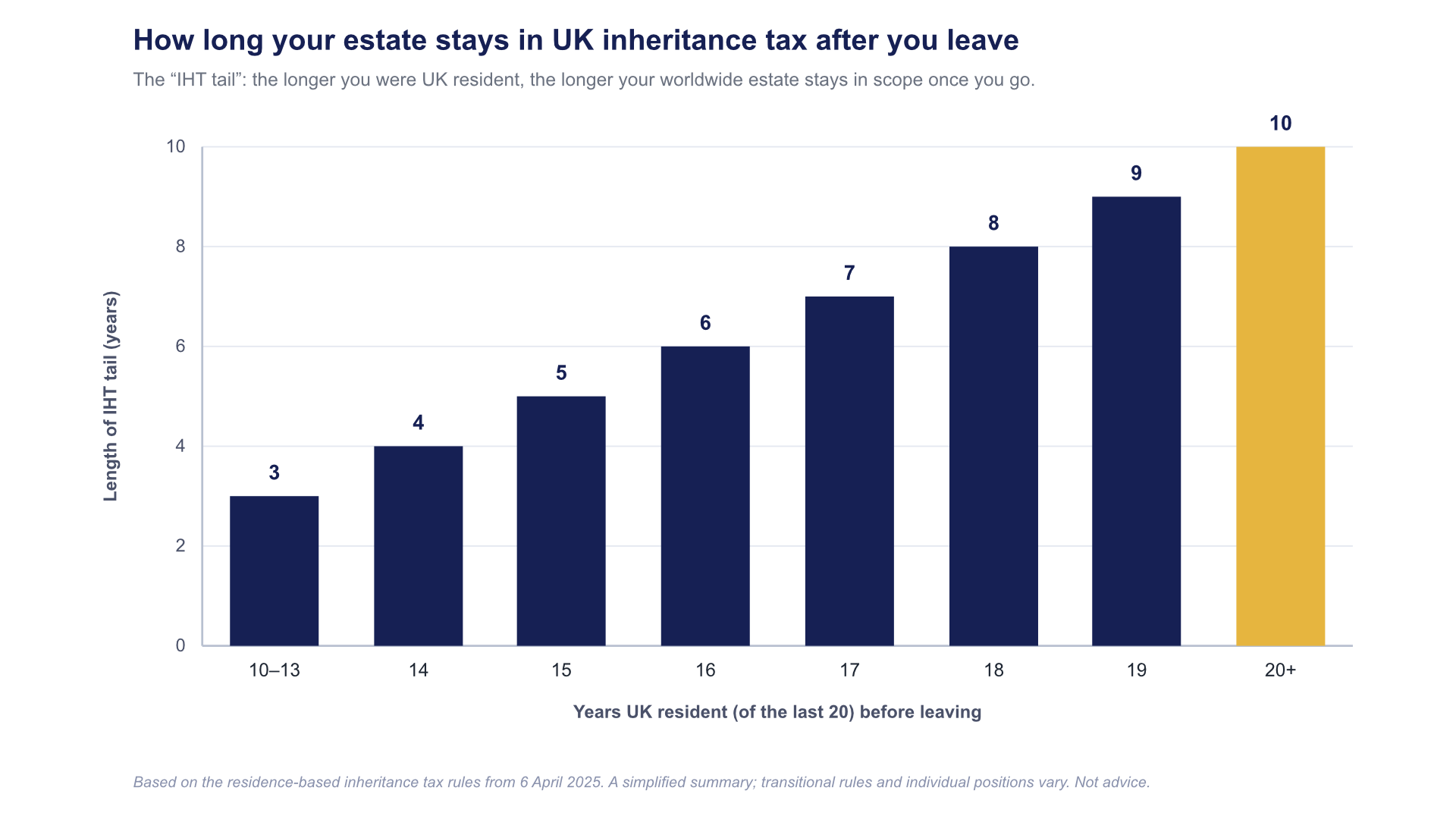
The practical takeaway is important: for a committed long-term expat, leaving properly and staying away long enough to serve out the tail can now take an entire worldwide estate outside UK inheritance tax. That simply was not reliably possible under the old domicile regime.
There are also transitional rules for people who were already non-resident in the 2025/26 tax year, which can apply a shorter three-year tail. This is one of many reasons to check your specific position rather than assume.
The numbers, and why they quietly get worse
Inheritance tax is charged at 40% on the value of an estate above the available allowances — the nil-rate band of £325,000, plus, where it applies, a residence nil-rate band of up to £175,000.
Both allowances have been frozen for years and are set to stay frozen. That freeze matters more than it seems. As property and investments rise in value while the tax-free threshold stays the same, more estates are taxed. This is a quiet increase that requires no change in the headline rate.
For an expat with a UK property and a lifetime of savings, it is easy to be closer to a 40% charge than you might expect.
One more change is coming that expats should note. From April 2027, UK pension funds are due to be brought within the scope of inheritance tax, subject to final legislation.
For anyone whose retirement savings are in a UK pension, this changes the estate-planning picture again. It is worth considering how expats structure their pensions in the first place.
If your wealth sits in a trust
Trusts are a cornerstone of estate planning, especially for expats. Someone who was non-UK domiciled could settle their foreign assets into an excluded property trust and, in general, keep those assets permanently outside UK inheritance tax. These assets would be protected regardless of what happened to their status afterwards.
The 2025 reforms changed that too. Whether the non-UK assets in a trust count as "excluded" — and so stay outside UK inheritance tax — is now tested against the settlor's long-term resident status at the time of each relevant event, using the same 10-of-20-year residence test that applies to individuals.
In plain terms, a trust's inheritance tax protection now depends on the settlor's residence position, rather than being locked in for good when the trust was created.
Structures set up on the old assumptions may no longer work as intended. Anyone holding an offshore trust should have it reviewed against the new rules, rather than assuming the original planning still stands.
Remember, trusts serve a different purpose from wills. Our article goes over the key differences between wills and trusts to help you understand both options.
A reality check for expats in the UAE and the Gulf
If you are building your life in Dubai, Abu Dhabi, or elsewhere in the Gulf, this applies directly. It is also widely misunderstood locally.
If you are still a long-term resident (10 of the last 20 years in the UK, tail included), your worldwide estate falls within the UK inheritance tax net. This includes the Dubai apartment, the offshore investment portfolio, and the cash in a Gulf bank account. All of it could be taxed at 40% on death.
Many Gulf-based Britons assume that living in a tax-free jurisdiction means their estate is tax-free too. It is not.
The UAE's lack of inheritance tax does not change your UK position, and if you still own UK property or have not yet served out your tail, you remain exposed.
There is also an opportunity. A Gulf-based expat who has been away long enough to shed long-term resident status, and whose wealth now genuinely sits outside the UK, may find the bulk of their estate falls outside UK inheritance tax altogether.
It is rarely as simple as moving assets offshore. Disposing of or relocating UK assets has its own tax consequences, and anti-avoidance rules mean you need to approach this carefully and with professional advice.
Which of those two situations you are in is not a matter of luck — It is a matter of planning.
What to actually do
Most expats fall into one of three situations.
If you have left recently after a long period of UK residence, you are likely still a long-term resident, with your worldwide estate in scope until your tail runs out. The priority is knowing how long that tail is.
If you are a long-standing expat who left more than a decade ago, you may already be outside long-term resident status, with only your UK assets exposed. It is worth confirming this and making sure your non-UK assets remain outside the UK.
If you are planning to move back, remember that your UK-resident years will start accumulating again, gradually bringing your worldwide estate back into the inheritance tax net.
For all three situations, you do not need to master the legislation. You do need to know three things about your own position: how many of the last 20 years you have been a UK resident, how long your tail would run if you left (or how much of it you have already served), and how much of your wealth is still in the UK.
Those three facts largely determine your exposure, and you can plan for each through the timing of a move, the location of your assets, gifting, and structures such as trusts.
Tax is only one part of estate planning. It is just as important to make sure your will is valid and effective in the countries where you hold assets, because many countries can override a UK will with forced-heirship rules.
Because the rules are new, individual, and genuinely complex, and because the government may adjust them again, you should get personalised, qualified advice rather than relying on assumptions.
If you would like to understand where your estate stands under the new rules and how to plan around them, our Estate Planning Guide and Estate Tax Planning resources are a good starting point.
A conversation with a regulated adviser and tax specialist can help you apply this to your own circumstances.
Talk to Holborn Assets about your estate.
UK inheritance tax and residence rules are complex, depend heavily on your individual circumstances and residence history, changed substantially on 6 April 2025, and may change again. The position and figures described are current as of July 2026 and should be verified against official UK government guidance at the time you act. You should seek advice from a qualified tax adviser and, where appropriate, a solicitor, specific to your situation, before making any decisions about your estate.
All information contained in this article was correct at the time of publication. This article is for informational purposes only and is not financial advice. For personal financial advice, always speak to a regulated professional.
Don’t just take our word for it...
We’re rated ‘Excellent’ on Trustpilot, based on thousands of verified reviews from real client experiences