When planning a move abroad, many expats underestimate healthcare until they actually need it.
Many people are surprised to learn that NHS access ends as soon as you stop being a UK resident. From there, your healthcare coverage and cost depend entirely on your new country, and systems can differ widely.
This article gives a straightforward ranking of the best and worst countries for UK expat healthcare in 2026. It shows where coverage is excellent and affordable, where it is world-class but expensive, and where it can be very costly. One key advantage is something many Britons do not realise they have.
How we've judged it
For expats, "good healthcare" means more than just clinical quality. It involves several factors, such as:
The quality of care
How easily a foreign resident can use the system
The cost for both public and private insurance
Whether English is commonly spoken in medical settings
For UK citizens, whether you qualify for help through the S1 form
The last factor changes everything, so we'll start there.
The UK expat's secret weapon: the S1 form
If you receive a UK State Pension and move to the EU, EEA or Switzerland, you can register for an S1 form. This entitles you to state healthcare in your new country on the same basis as a local, with the UK covering the cost.
In practice, it can give a British retiree in France, Spain or Portugal near-free access to a good public health system.
The S1 form is one of the most valuable benefits available to UK expats. It’s also the single biggest reason the European destinations dominate the "best" end of this ranking. Rules and eligibility can change, so confirm your position against official UK government guidance before relying on it.
For shorter visits rather than residency, the GHIC card is the separate, more limited arrangement.
The best: Europe, especially with an S1
France
France often leads healthcare rankings because of its consistently high quality. Registered residents can join the public system (PUMa) after a few months and usually add affordable "mutuelle" cover. For pensioners with an S1, the mix of quality and cost is hard to match.
Best for: outright quality of care.
Spain
Spain has a strong universal healthcare system and the largest British community abroad. UK pensioners can use the S1 to access it, while younger residents can contribute through work or pay a modest monthly fee to join the public system through the "convenio especial." English is widely spoken in areas with many expats.
Best for: an established, leading healthcare system.
Portugal
Portugal provides universal public coverage (the SNS) with very low co-pays, often just a few euros. For those who want faster access or English-speaking specialists, private insurance is also available at a low cost. The S1 is accepted here as well.
Best for: affordability.
Cyprus
Cyprus has developed a general healthcare system (GESY) in recent years, greatly improving access for residents. English is widely spoken, and pensioners can use the S1 here too.
Best for: an English-speaking transition.
Italy, Malta, and Greece all have good public healthcare systems and accept the S1. However, Greece's public system is under more pressure, so many expats there also choose private insurance.
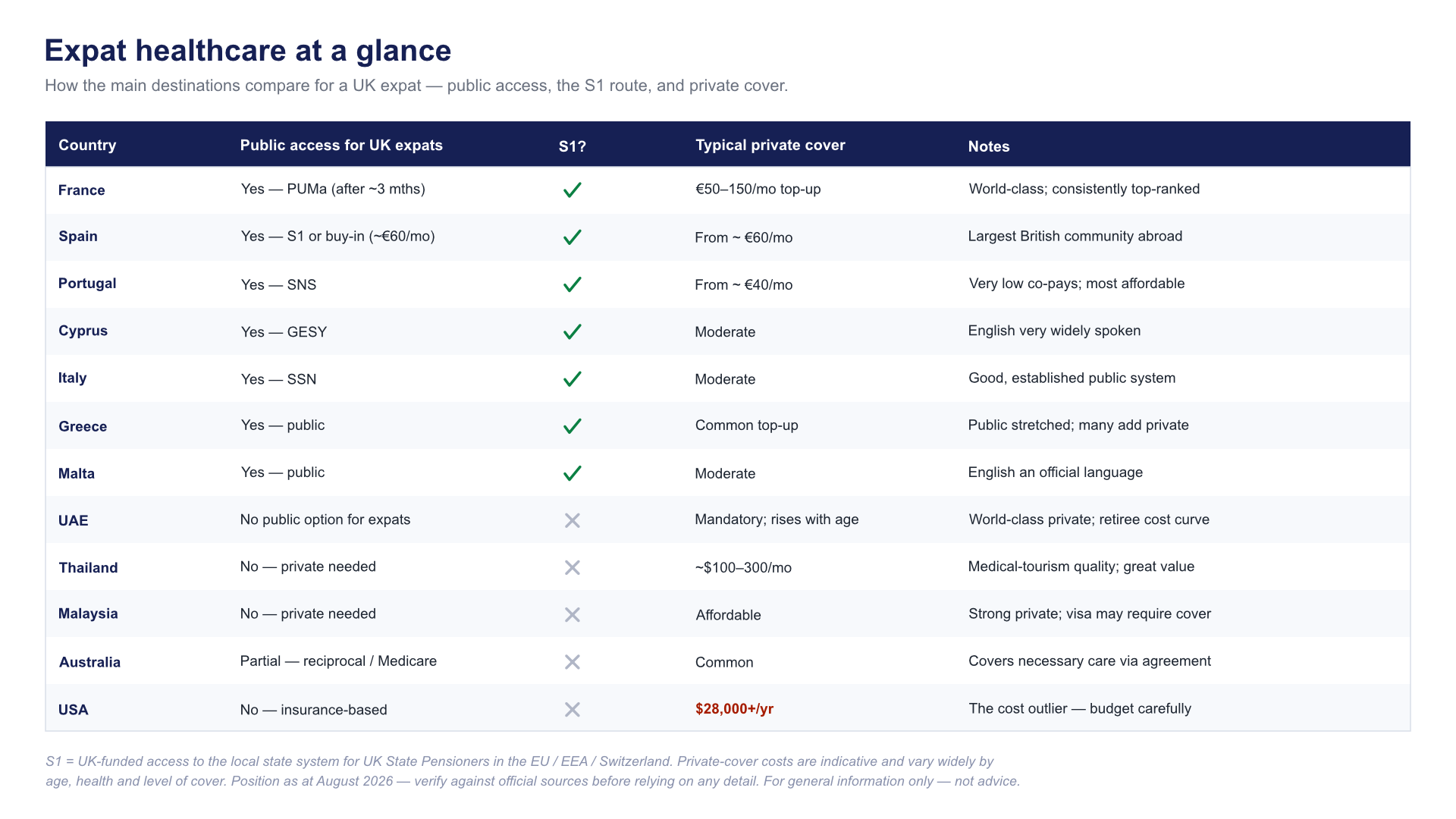
The common thread: in the EU or EEA, a UK pensioner with an S1 can access a good healthcare system at low cost. This combination is rare outside these regions.
Strong, but pay-to-play
Outside Europe, healthcare quality can be excellent, but you usually need to buy private insurance instead of using a state system.
The UAE
The UAE has world-class private hospitals, and health insurance is required. Most employees get insurance through their employer, so it is not a concern while you are working.
The challenge comes later in life. There is no public system for expats, and private insurance premiums increase sharply with age. Retirees without employer coverage may face high and rising costs. The care is excellent, but you need to plan for these expenses.
Thailand and Malaysia
Both Thailand and Malaysia are popular medical-tourism destinations with high-quality, affordable private care, often costing much less than in Western countries. There is no reciprocal agreement with the UK, so you will need private insurance, and some long-stay visas require it. For many people, the value is excellent.
Australia
Australia is a middle case. The UK has a reciprocal agreement that covers medically necessary treatment, but long-term residents need to use Medicare through their visa or get private insurance.
The worst: the United States
When it comes to cost, one country stands out. The United States offers excellent clinical care, but the system is so expensive that it is in a category of its own.
International insurance plans that include US coverage can cost tens of thousands of pounds a year, which is many times more than similar policies in most other countries.
That is why "worldwide excluding USA" is one of the most popular expat insurance options. If you are moving to the US, healthcare costs should be at the centre of your budget planning.
What cover actually costs
Some rough example figures can help set expectations. These vary a lot by age, health, and level of cover, so use them as a starting point, not a quote:
Public-system top-ups in Europe are modest. A French "mutuelle" often costs €50 to €150 a month, Portuguese private cover starts around €40, and Spain's public buy-in is about €60. These are on top of state access that an S1 may give a pensioner for free.
Private cover in Asia is good value. Comprehensive plans in Thailand usually cost between US$100 and US$300 a month for good private care.
International (multi-country) policies average about US$3,000 a year for an individual. Add the United States, and plans can jump to US$28,000 or more. This big difference explains why "worldwide excluding USA" is such a common choice.
The pattern is clear. In much of Europe and Asia, good cover is affordable. The US is the one place where healthcare can take over your whole budget.
The traps that catch expats out
Wherever you land, a few pitfalls recur:
The coverage gap: The riskiest moment is the move itself, which is the time between NHS access ending and your new cover starting. Arrange insurance
before you leave.
The age curve: Private premiums rise quickly as you get older, which can turn an affordable policy in your fifties into a high cost in your seventies. This is a particular issue in the Gulf and Asia, where private cover is required.
Pre-existing conditions: These are often excluded or come with extra costs, and they get harder and more expensive to cover the longer you wait. This is another reason to arrange cover early.
Visa requirements: Many long-stay visas require proof of health insurance, so it's often a condition of moving, not an afterthought.
The bottom line
For UK expats, the "best" countries are not just those with the best hospitals. They are the places where you can get good care at an affordable price.
By this measure, the EU and EEA are the best, mainly because of the S1 form. The Gulf and Asia offer excellent private care if you plan for rising premiums. The US is the one place where mistakes can be the most costly.
Healthcare costs, especially as you get older, can quietly change whether a destination is truly affordable. Include them in your retirement planning from the start, along with the cost of living and taxes. It is one of the factors in our article on where you can afford to retire abroad.
If you would like help including healthcare in your plans for living abroad, talk to Holborn Assets.
All information contained in this article was correct at the time of publication. This article is for informational purposes only and is not financial advice. For personal financial advice, always speak to a regulated professional.
Don’t just take our word for it...
We’re rated 4.8 out of 5 on Feefo, based on verified reviews from real client experiences
 4.8 / 5