When you move to South Africa from the UK, you’ll enjoy more space, a pleasant climate, and a cost of living that stretches your pension or salary. There’s also a large established British community.
Newcomers often underestimate South Africa's tax system. Residents are taxed on their worldwide income; there’s an inheritance tax in all but name, and you may face a departure tax if you decide to leave.
When do you become a South African taxpayer?
This is the key point, and it’s not about your visa. South Africa uses two main tests:
Ordinarily resident: This is where your permanent home and settled life are—intention matters, not the number of days.
Physical presence: This is more straightforward. You meet this test if you spend more than 91 days in South Africa in the current tax year, more than 91 days in each of the previous five years, and over 915 days in total during those five years. → Learn more about the physical presence test.
If you meet either test, SARS will tax your worldwide income. This includes UK rental profits, investment income, and pensions, not only what you earn in South Africa.
This does not replace your UK tax status. The Statutory Residence Test determines whether the UK still has a claim, and the UK–South Africa double tax agreement helps resolve overlaps. Both countries can tax you at the same time.
→ Am I still a UK tax resident?
What South Africa taxes
If you are moving from the UK to South Africa, there are four main taxes to know about:
Income tax: Once you’re a resident, you’ll pay progressive rates from 18% to 45% on your worldwide income.
Capital gains tax: A portion of your gains is added to your taxable income, resulting in an effective rate of up to about 18% for individuals.
Estate duty (South Africa’s inheritance tax): This is 20% on estates up to R30 million and 25% above that. If you’re a resident, it applies to all your worldwide assets. For non-residents, it only covers assets in South Africa.
Donations tax: The rates are similar, which makes it harder to use lifetime gifts as an estate-planning option.
The estate duty issue is important. If you become a South African tax resident, your global estate is subject to SA estate duty. If you are also a long-term UK resident, UK inheritance tax could apply to the same assets simultaneously. This is a situation where you need specialist cross-border advice.
→ UK inheritance tax for expats
The exit tax: the one nobody warns you about
This tax surprises most people. When you stop being a South African tax resident, SARS treats it as if you sold all your worldwide assets at market value the day before you leave and charges capital gains tax on unrealised gains. This is called a deemed disposal under section 9H, and most people call it the exit tax.
South African property is not included, but investments and offshore holdings are. If you spend ten years here and your portfolio grows, your departure tax bill could be quite large.
There are two important things to know. Since March 2021, stopping your tax residency is a SARS process, not the old Reserve Bank method. You must formally declare it and get confirmation that you are a non-resident. Just leaving the country is not enough.
If you don’t follow the process, you could still be liable for worldwide tax for years. From July 2025, you will also need to notify SARS if you return and become a resident again.
If you think South Africa might be a chapter in your life, not your final destination, work out the costs of both moving there and leaving before you decide.
Your UK ties
Your State Pension will be frozen
South Africa is not on the UK’s uprating list, so the rate you get when you first claim your State Pension is the rate you keep for life. Over a long retirement, this loss adds up, so private savings become more important.
→ The frozen State Pension trap
Your ISAs freeze, and SARS may tax them
You can keep your existing ISA, but you cannot add to it while you are not a UK resident. SARS does not recognise the ISA wrapper, so the income and gains inside it are usually taxable in South Africa.
Your UK pensions need a decision, not a transfer pitch
Under the double tax agreement, UK pension income is usually taxed in South Africa instead of the UK, and an HMRC "NT" code may let it be paid gross. If you transfer a UK pension overseas, it can trigger a 25% charge, so be wary of any unsolicited offers.
→ QROPS vs SIPP vs leaving it in the UK · the transfer charges that catch expats out
UK property stays in the UK net
The Non-Resident Landlord Scheme, non-resident capital gains tax with its 60-day reporting deadline, and UK inheritance tax on UK property all still apply no matter where you live.
→ Funding a UK property from abroad
The rand: your biggest practical variable
Currency is especially important here. The rand can fluctuate greatly in value, which can help or hurt you. If you earn in pounds and spend in rand, a weak rand makes South Africa much more affordable. That is why British retirees often find their money goes further.
Your purchasing power can change significantly even if you do nothing. If you are saving in rand to spend later in pounds, you face the opposite risk.
South Africa also has exchange controls, so moving money out means dealing with rules, limits, and approvals not found in most other countries. Plan your transfers carefully.
→ The cost of moving money · managing currency exposure
Healthcare: budget for private cover
The public healthcare system is under a lot of pressure, so almost all expats end up using private medical insurance.
The quality of care is excellent, and South Africa is known for medical tourism. However, private medical insurance is a monthly cost that rises quickly as you get older, and there’s no agreement with the UK. Budget for this as a permanent expense, especially if you plan to retire here.
→ Expat healthcare: the best and worst countries
Your estate and your will
Make a South African will to cover your SA assets alongside your UK one, and draft them so neither cancels out the other. Because a cross-border estate can be taxed in two countries, getting early estate advice is well worth it.
→ Wills and trusts for British expats · probate for expats
Summary: your money in South Africa
Here is a summary of everything mentioned in this guide and what it means for your finances if you are moving from the UK to South Africa.
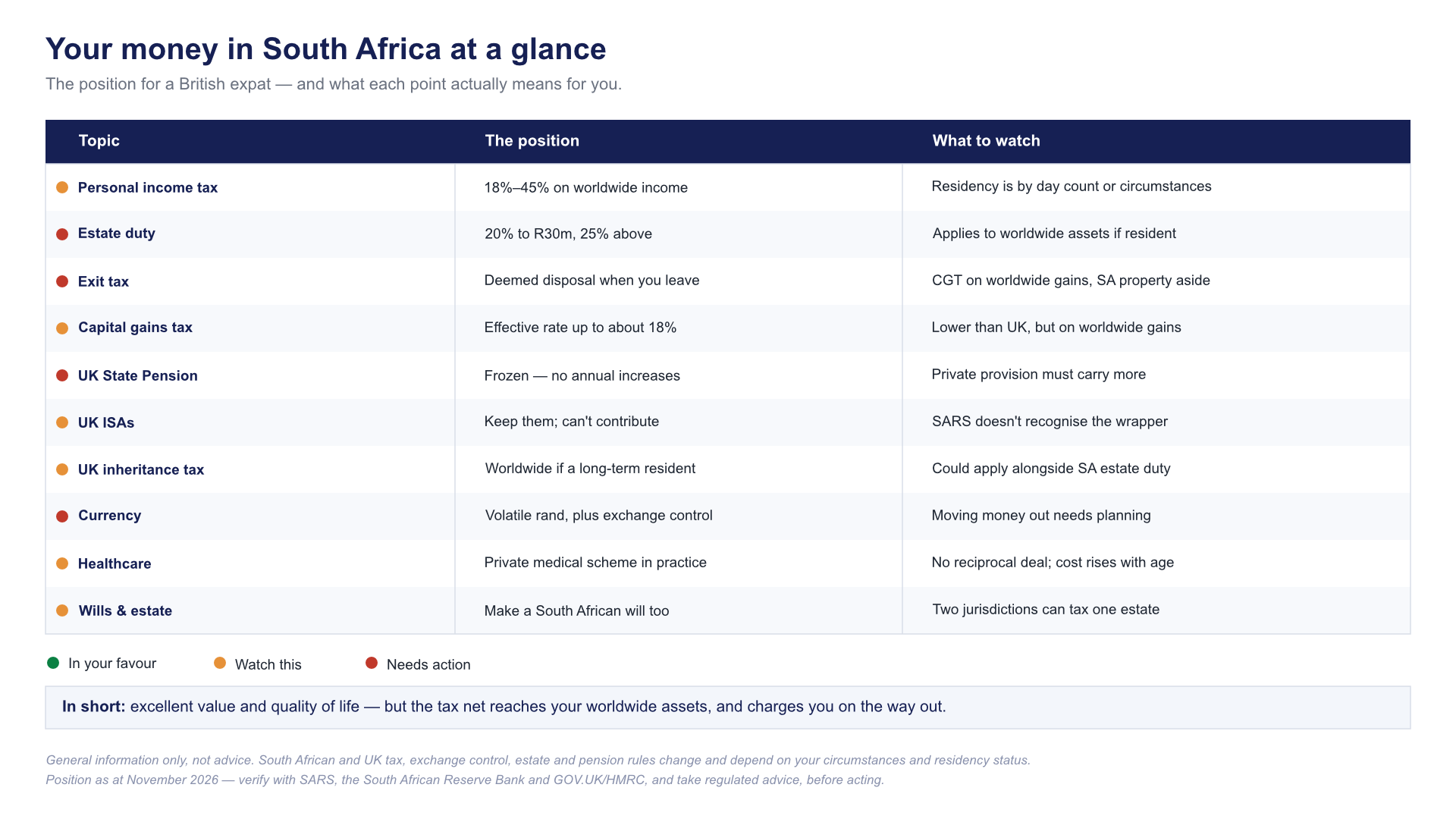
The South Africa money checklist
Work out when you’d become an SA tax resident. Check both the ordinarily resident and physical presence tests.
Understand your residency status. This can affect your worldwide taxation, not just your local income.
Model the exit tax before you arrive, especially if there’s any chance you’ll move on.
Plan for estate duty and the possibility of UK IHT applying at the same time.
Accept the frozen State Pension and build up private savings to make up for it.
Review your ISAs, as they’re frozen and likely taxable locally.
Budget for private medical cover, and remember it will get more expensive as you get older.
Learn the exchange control rules before you need to move your money.
Make a South African will as well as your UK one.
Plan your currency conversions carefully, as the rand can reward good timing.
South Africa offers a great quality of life at a cost that’s hard to beat. It just needs more careful planning than most places, because the tax system reaches further in both directions than most people expect.
If you’d like help making your UK and South African finances work together, get in touch with Holborn Assets.
Guides for other countries
Part of our series on money for British expats, country by country:
All information contained in this article was correct at the time of publication. This article is for informational purposes only and is not financial advice. For personal financial advice, always speak to a regulated professional.
Don’t just take our word for it...
We’re rated 4.8 out of 5 on Feefo, based on verified reviews from real client experiences
 4.8 / 5