Australia is the top destination for British expats, even ahead of places like the UAE. However, finances work very differently from the Gulf.
You won’t find tax-free salaries in Australia. Instead, income is taxed at rates similar to what you’re used to. In return, you get benefits the Gulf doesn’t offer, like a real, compulsory pension system and healthcare you can actually use without needing medical insurance.
There is a major drawback: Australia is a frozen State Pension country. This means your UK State Pension will stop increasing once you start claiming it in Australia. Also, moving a UK pension into the Australian system is much more difficult than many people expect.
Here's the full picture.
What Australia taxes
Australian tax residents pay tax on their worldwide income at progressive rates. There is a tax-free threshold, and the rates increase in bands from there. This is similar to the UK, but the thresholds differ.
In addition to income tax, you pay a Medicare levy, usually 2% of your taxable income, to help fund the public health system. If you earn more and don't have private hospital cover, you may also pay a Medicare Levy Surcharge. This is why many expats choose private health insurance, as it can be cheaper than paying the surcharge.
Australia also taxes capital gains as income, but you get a 50% discount on assets held for more than 12 months. One real advantage is that Australia has no inheritance tax or estate duty. This differs significantly from the UK, although your estate may still be subject to UK inheritance tax.
Your residency status is very important, and Australia determines it differently from the UK. The Australian Tax Office (ATO) uses several tests, such as the residence test, the domicile test, and the 183-day test.
You can be considered a tax resident in Australia while still being seen as a UK resident under the UK's Statutory Residence Test. The UK–Australia double tax agreement helps resolve dual residency, but you should understand how it works before you move.
→ Am I still a UK tax resident?
Superannuation: the pension system you didn't have in the Gulf
If you have moved from the Middle East, this is the biggest difference. In Australia, your employer must pay a Superannuation Guarantee of 12% of your earnings (as of July 2025) into a super fund in your name, on top of your salary.
Superannuation tax rules are designed to be generous.
Contributions and fund earnings are generally taxed at a concessional 15%
Withdrawals are typically tax-free after age 60 from a compliant fund
There's a Transfer Balance Cap (AUD 1.9 million as at 2026) limiting how much can move into the tax-free retirement phase, and higher tax applies to very large balances
For a mid-career British expat, superannuation often becomes one of their biggest assets. It is a valuable benefit, but it is also preserved, which means you usually cannot access it until you reach your preservation age. This can cause complications if you decide to leave Australia later.
The UK pension trap: transferring is harder than you think
This is an area where expats often run into trouble, so it is important to be clear.
It is possible to transfer a UK pension into Australian superannuation, but there are four strict conditions that all need to be met:
You usually need to be at least 55 years old (this will rise to 57 from April 2028). This is the main requirement. HMRC says any receiving scheme must restrict access until the UK's normal minimum pension age, and most Australian super funds cannot do this. So, if you are under 55, you usually can't transfer.
You must be an Australian tax resident. This removes the 25% overseas transfer charge because the scheme is in your country of residence.
The pension must be a transferable type.
The receiving fund must have current QROPS status. Here is the catch:
most mainstream Australian retail super funds are not QROPS. Only a small number of specialist funds and QROPS-compliant self-managed super funds qualify.
If you transfer to a scheme that isn't a genuine QROPS, you could face UK unauthorised-payment charges of 40% or more, sometimes up to 55%. Do not make this decision based on advice from someone who contacts you unexpectedly.
In practice, many British expats in Australia, especially those under 55, simply leave their UK pension where it is and draw from it later.
Under the UK–Australia double tax agreement, Australia usually taxes UK private pension income instead of the UK, so an NT code may allow it to be paid gross. This is often a good solution and much safer than trying to force a transfer.
→ QROPS vs SIPP vs leaving it in the UK · the transfer charges that catch expats out
Your UK State Pension will be frozen — permanently
This can be the most costly part of moving to Australia, and it can catch British expats by surprise.
Although the UK and Australia have a social security agreement, it doesn't allow increases. This means the UK State Pension is frozen for pensioners in Australia. The rate that applies when you first claim it stays the same for life, with no annual triple-lock increases.
The effect adds up over time. A pensioner who retired to Australia ten years ago may now receive much less than someone with the same record who stayed in the UK, and the gap grows every April. Over twenty years, the total loss can reach tens of thousands of pounds.
This does not mean you should not move. It means your private savings will need to do more, and it is a good reason to think about your State Pension options well before you retire. This includes considering whether to pay voluntary National Insurance to maximise the (frozen) amount you will receive.
→ The frozen State Pension trap · The State Pension in 2027
Your other UK ties
Your ISAs freeze, and Australia may tax them
You cannot contribute while you are a non-resident. The situation is even less favourable than in the Gulf because Australia does not recognise the ISA wrapper. This means income and gains inside it are generally taxable for an Australian resident. An ISA that is tax-free in Britain can become a taxable, reportable asset in Australia.
UK inheritance tax may still reach your estate
Australia has no inheritance tax, which may seem like an escape. However, UK inheritance tax now follows your residence. If you have been a UK resident for 10 of the previous 20 tax years, you are considered a "long-term resident", and your worldwide estate remains in scope, with this rule lasting for years after you leave. UK property is always in scope.
→ UK inheritance tax for expats
UK property
If you keep your UK property and rent it out, the Non-Resident Landlord Scheme applies, and you may also pay non-resident capital gains tax, with a 60-day reporting deadline.
→ Funding a UK property from abroad
Healthcare: Medicare, and what the reciprocal agreement really covers
Britain and Australia have a reciprocal healthcare agreement that lets UK nationals get medically necessary treatment through Medicare. This is a real benefit, and it offers more than most non-EEA countries.
Keep two things in mind. First, "medically necessary" is more limited than full coverage. It isn't a substitute for private health insurance and doesn't cover everything. Second, most long-term residents pay the 2% Medicare levy, and higher earners without private hospital cover also pay the surcharge. In practice, many expats still keep private cover.
→ Expat healthcare: the best and worst countries
Currency: a pound–Australian dollar story
Unlike the dirham, the Australian dollar floats, and the GBP/AUD exchange rate has changed a lot over the years. If you are paid in Australian dollars but still have UK commitments, such as a mortgage, school fees, or family support, or if you plan to bring your savings back to the UK, this currency exposure is real and should be planned for, not just accepted.
→ The cost of moving money · managing currency exposure · what the pound has done this decade
Your estate and your will
Australia does not have inheritance tax, but you still need a valid will that covers your Australian assets. Australian succession law is state-based, and a UK will may not properly cover property in Australia. The usual approach is to have a will in each country, drafted so they do not cancel each other out.
→ Wills and trusts for British expats · probate for expats
If you move back
Moving back to the UK brings its own challenges. Your superannuation usually stays preserved in Australia and cannot simply be transferred home. The timing of your return affects your UK tax position, and if you have been away for ten years or more, you might qualify for four tax years of UK relief on foreign income and gains.
Summary: your money in Australia
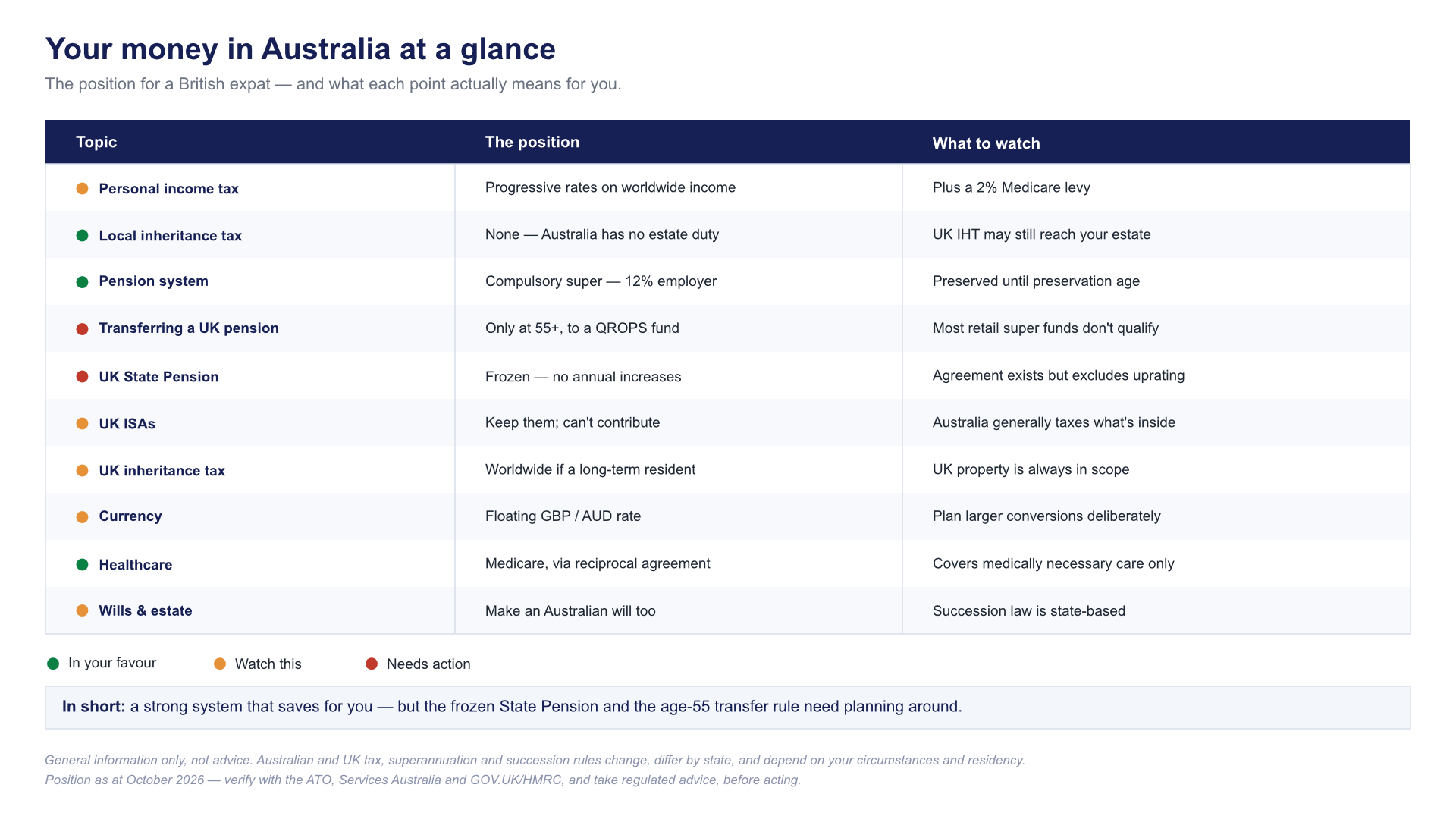
Here is a summary of everything mentioned in this guide and what it means for your finances as a British expat in Australia.
The Australia money checklist
Find out your residency status: Check both the ATO tests and the UK's Statutory Residence Test.
Take an active role in your superannuation: Pick your fund, review your investment options, and combine any duplicate accounts.
Don't assume you can transfer your UK pension: If you're under 55, you generally can't.
Be cautious about pension transfer offers: Always check the QROPS status yourself on the HMRC list.
Understand that your State Pension will be frozen: Plan private savings to cover the gap.
Review your National Insurance record: Check whether voluntary contributions would benefit you.
Check your ISAs: They are frozen, and Australia might tax the money in them.
Arrange private health insurance: Otherwise, you may have to pay the Medicare Levy Surcharge.
Create an Australian will: This is in addition to your UK will.
Plan your currency conversions: Don’t just accept whatever exchange rate is available at the time.
Australia offers British expats a strong, well-structured financial system with compulsory pension saving, real healthcare, and no inheritance tax.
You still need to manage what Australia doesn't fix for you: the frozen State Pension, a UK pension you may not be able to move, and an estate that may still be within reach of UK inheritance tax.
If you would like help making your UK and Australian finances work together, contact Holborn Assets.
All information contained in this article was correct at the time of publication. This article is for informational purposes only and is not financial advice. For personal financial advice, always speak to a regulated professional.
Don’t just take our word for it...
We’re rated 4.8 out of 5 on Feefo, based on verified reviews from real client experiences
 4.8 / 5