Almost everyone has wondered at some point, even if they don’t say it out loud: how much money do you really need to be considered wealthy?
The truth is, there isn’t a set point where you suddenly become wealthy. It’s subjective. Still, there are real numbers to consider. For British expats, these numbers are especially interesting since living abroad changes both the standards you’re compared to and what your money can do.
Let’s look at what the data shows, and why the number most people focus on might not be the right one.
The UK benchmarks
Let’s start with where British households stand. The latest official data from the ONS Wealth and Assets Survey and another report on private wealth in the UK show:
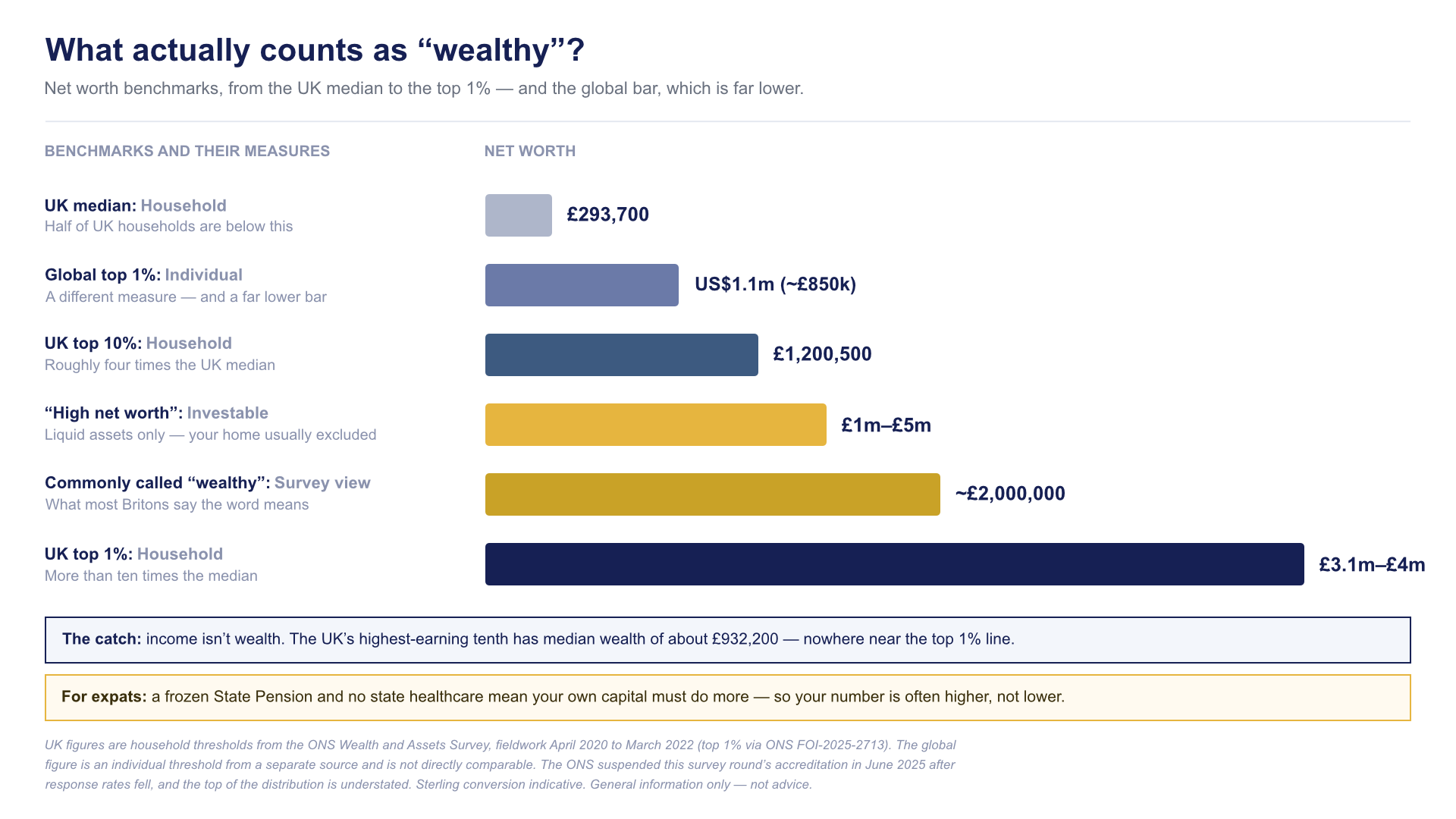
Median household net worth: £293,700: Half of households have more, half less
Top 10%: £1,200,500 or more: Roughly four times the median
Top 1%: at least £3,121,500: More than ten times the median
Two important things to keep in mind about these numbers. The surveys were done a few years ago, so today the top 1% line is closer to £4 million. Statisticians also warn that data at the very top is less reliable and the wealthiest are hard to survey, so the real numbers might be higher.
When people are asked what they consider wealthy, most say around £2 million. That puts you in the top few per cent, but still below the real top 1% line.
The distinction that matters most: income isn't wealth
Here’s something that should change how you think about the question, especially if you’re an expat with a good salary.
In the UK, the top 1% by income starts at about £207,000 a year. The top 1% by wealth starts at about £3.1 million in net worth. These are mostly different groups of people.
Even more striking, the highest-earning tenth of households has a median wealth of about £932,200, far below the top 1% wealth threshold. A big salary alone doesn’t make you wealthy. It gives you the chance to become wealthy, but only if you turn your income into assets.
For expats, this is what really matters. A tax-free Gulf salary is one of the best ways for a British professional to build wealth, but it’s easy to waste since nothing turns it into savings automatically. There’s no auto-enrolment building a pension and no employer contribution.
The difference between expats who leave wealthy and those who don’t is almost never the salary—it’s what they did with it.
→ Dubai vs London vs Singapore: where does your salary go furthest?
The expat complication: wealthy compared to whom?
Living abroad quietly changes your reference point. This is where the question becomes different for you.
Globally, the bar is far lower than in the UK
A net worth of around US$1.1 million puts you in the world's top 1%. Compared to the UK's £3.1 million or more, that is a big difference. The global threshold has risen by 26% in real terms over the past decade.
Locally, it depends entirely where you are
The same portfolio that feels substantial in Kuala Lumpur or Cape Town might seem unremarkable in Monaco, Zurich, or central London. Expats often compare themselves to those around them, but that is not always a good measure.
And your costs aren't where your benchmark is
Here is the practical point: if you’re building wealth in dirhams but plan to spend it in pounds or euros, your real position depends on the exchange rate when you convert, not just your current balance. Over the past decade, changes in sterling’s value have shifted expat net worth by five figures, even if you have not done anything.
→ What the pound has done to your savings this decade
What the industry means by "high net worth"
To be considered a high-net-worth client, the definitions are actually looser than they sound:
High net worth (HNWI): commonly £1 million to £5 million in liquid assets; internationally, often US$1 million+ in investable assets
Very high net worth: around US$5 million+
Ultra-high net worth (UHNWI): usually US$30 million+
Notice the key word here: liquid, or investable. Under formal definitions, your main home usually doesn't count. That’s a useful reminder because UK property wealth can make many balance sheets look better than they are.
Someone with a £900,000 house and £150,000 invested isn’t in the same financial position as someone renting with £1 million in a portfolio, even if their net worth looks similar.
The better question
All of this suggests that asking "am I wealthy?" is less useful than it seems. It’s a comparison, and comparisons never end. There’s always someone with more, and chasing a percentile is a sure way to feel poor at any income.
The question that actually helps is: what does my money need to do, and does it do it?
For most expats, that resolves into something concrete:
Could you stop working and maintain your life, and for how long?
If your income stopped tomorrow, how long before it hurt?
Have you replaced what the UK system would have provided automatically, such as a pension, healthcare, or an inflation-linked State Pension?
Will your money be in the right currency, in the right place, when you need it?
That last group of questions is why the expat number is often higher than the domestic one. If you retire somewhere, your State Pension is frozen.
You lose an inflation-linked income stream a UK resident keeps. If there is no state healthcare, you must pay for a cost that rises quickly as you age. Both mean your own capital has to work harder.
→ How much do you need to retire abroad? · The frozen State Pension trap
So, what's the number?
At the start, we asked: how much money do you really need to be considered wealthy?
There is no magic number. Here’s the honest version: by UK standards, £2 million is what most people call wealthy, and £3 million to £4 million puts you in the top 1%. Globally, around US$1.1 million does. By industry definition, £1 million in investable assets, not counting your home, generally makes you a high-net-worth client.
But the more useful number is personal, and it's the one our retirement calculator is built to estimate: the capital you need to fund the life you want, wherever you plan to live, for as long as you need it. For many expats, that figure is between the £1 million "high net worth" label and the £3 million "top 1%" line. This reminds us that the labels and the reality aren’t the same.
In the end, wealth is less about a threshold and more about whether your money does its job. If you’d like help figuring out what your number actually is, speak to Holborn Assets.
All information contained in this article was correct at the time of publication. This article is for informational purposes only and is not financial advice. For personal financial advice, always speak to a regulated professional.
Don’t just take our word for it...
We’re rated 4.8 out of 5 on Feefo, based on verified reviews from real client experiences
 4.8 / 5