Every expat job offer comes with the same question: Will I really be better off?
A Dubai job offer can seem life-changing compared to a London salary, while Singapore usually falls in the middle. But the headline numbers don’t tell the whole story. Lower taxes mean you keep more, but higher rents can quickly eat into those gains.
We’ve carefully compared the numbers for the three cities British professionals most often consider. The results are more surprising than most people think, and the real answer isn’t as simple as just saying "Dubai wins".
How we compared them
Here’s how we compared the cities, step by step:
Take-home pay: For London: We used UK income tax and National Insurance rates for 2026/27. Dubai has no personal income tax. In Singapore, the effective tax rate is about 11% for a typical expat salary under its 0–24% progressive system. (Employment Pass holders don’t pay CPF.)
Cost of living: We used published indices for a single person’s monthly expenses, including rent. On average, it’s about $2,470 in Dubai, $3,105 in Singapore, and $3,662 in London. That means Singapore costs about 26% more than Dubai, and London about 48% more.
Real spending power: This is your take-home pay after adjusting for the cost of living. It’s the key number that really answers the question.
These are averages, and your costs will vary depending on your neighbourhood, lifestyle, and family size. Still, the overall pattern is clear and stays the same across different income levels.
Step one: what you keep
The first big difference is the tax gap. On an £80,000 salary:
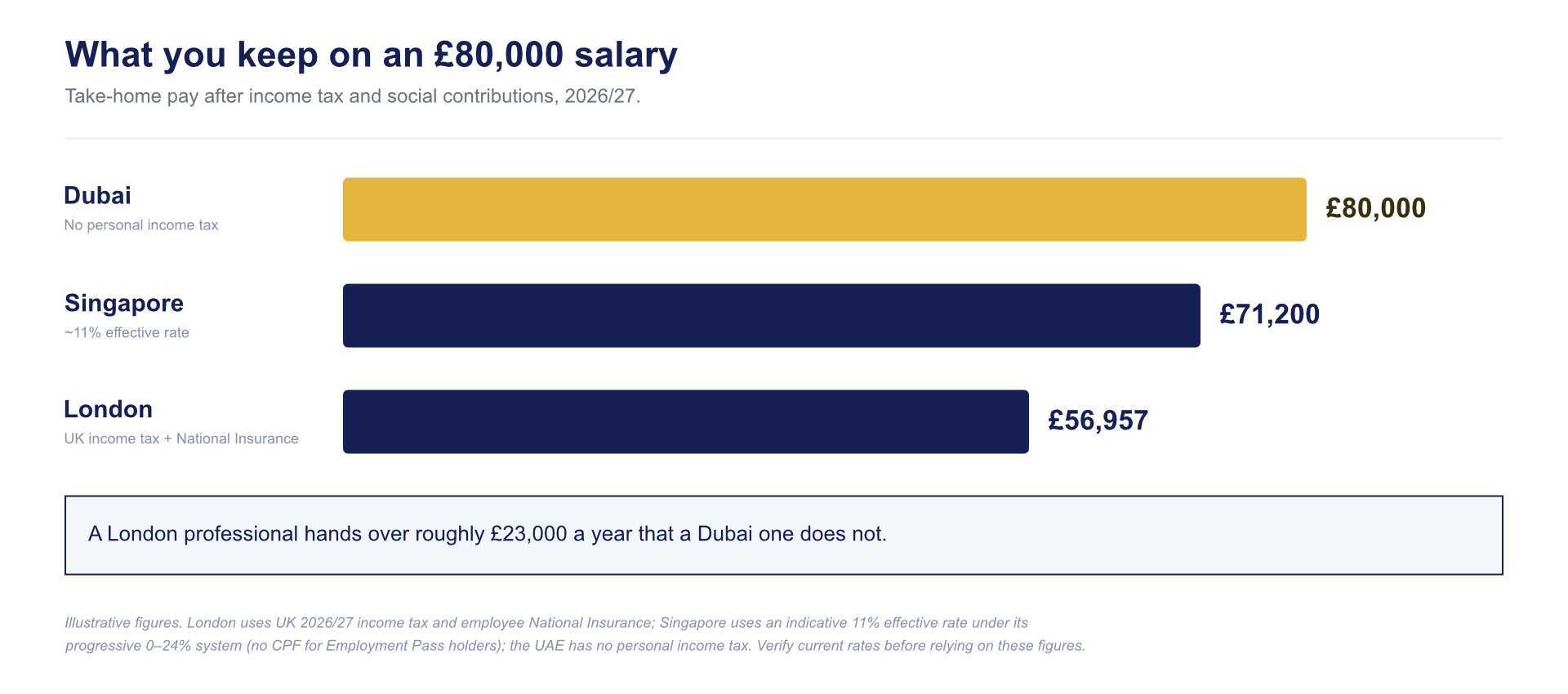
A professional in London pays about £23,000 a year in income tax and National Insurance. In Dubai, you pay nothing. Singapore is in the middle, letting you keep about 89% of your gross salary.
Put another way, on the same salary, someone working in Dubai takes home £23,000 more each year than someone in London, even before you consider living costs.
Step two: what it costs to live
This is where Dubai’s advantage shrinks but doesn't disappear. London is the most expensive of the three for almost everything: rent, utilities, transport, and eating out. Dubai also doesn't have council tax, which quietly removes a cost Londoners cannot avoid.
Singapore surprises many people because its rents are similar to London’s, and owning a car is famously expensive. Its main advantage over London is tax, not cost.
Step three: the real answer
When you combine both factors, you get the number that really matters. Starting from the same £80,000 salary, the equivalent spending power is:
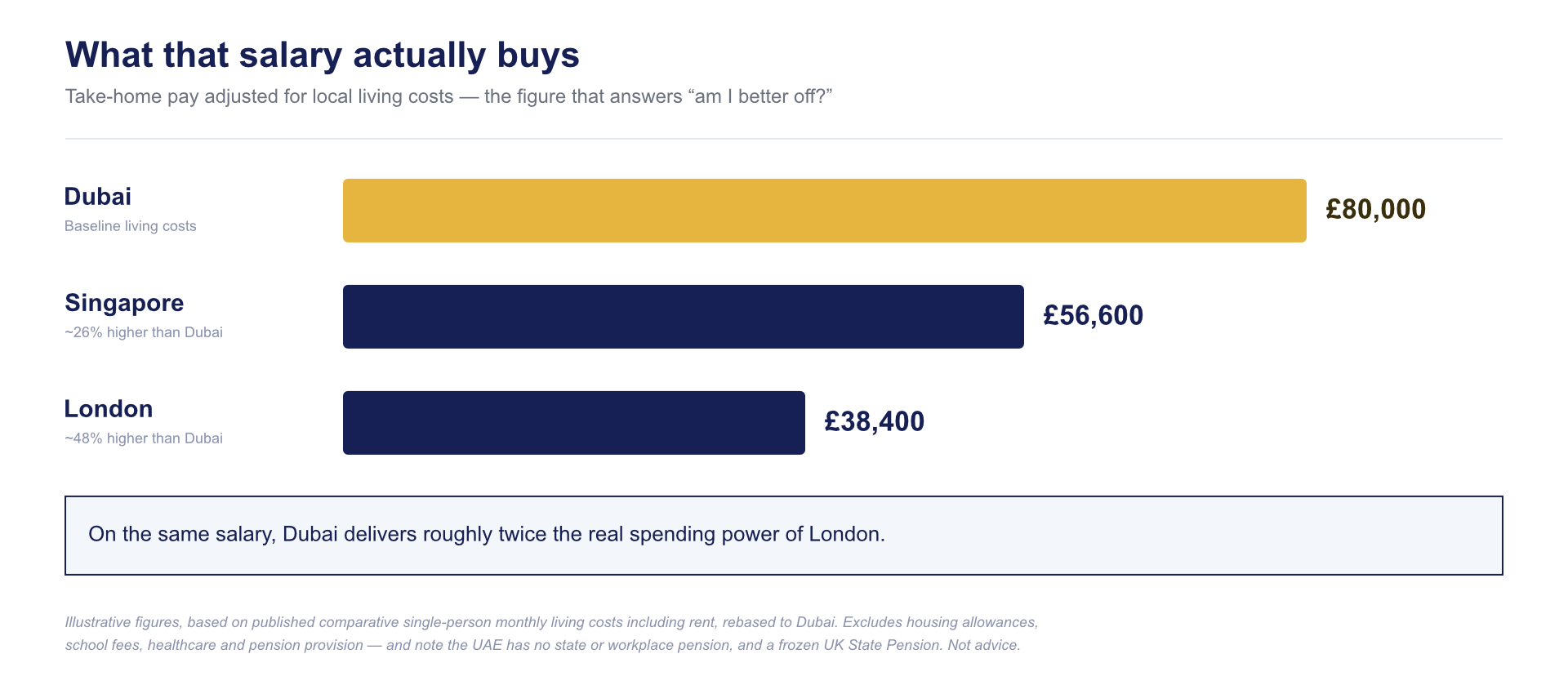
Take another look at those numbers. On the same salary, Dubai gives you about twice London's real spending power, and about 40% more than Singapore.
This pattern holds at other salary levels. At £60,000, the numbers are about £60,000 in Dubai, £42,500 in Singapore, and £30,600 in London. At £120,000, where London’s higher tax rates have the biggest impact, the figures are £120,000, £85,000, and £54,100.
Also, as salaries rise, the gap widens. UK tax rates increase with higher earnings, but Dubai’s tax stays at zero. So, the more you earn, the more valuable a move becomes in cash terms.
Why "Dubai wins" is the wrong conclusion
This is where most comparisons end, but where the really useful analysis begins. Those numbers show spending power, not financial security, and the three cities offer very different returns on your taxes.
London gives you things Dubai doesn't
Your UK income tax funds the NHS. Your National Insurance builds entitlement to a State Pension that rises every year under the triple lock.
Auto-enrolment means your employer pays into a pension for you, even if you do not think about it. None of this exists in Dubai. There is no state or workplace pension for expats, healthcare is private, premiums rise quickly as you get older, and your UK State Pension is frozen if you retire there.
The comparison isn't really £80,000 versus £56,957
It is £80,000 with no pension, no public healthcare, and no inflation-linked State Pension, compared to £56,957 with all three. Dubai's advantage is real, but much of it is money you must set aside yourself to match what the UK system provides automatically.
Singapore sits in between
Singapore has a well-regarded healthcare system and lower taxes. However, the Central Provident Fund that funds Singaporeans' retirement doesn't apply to Employment Pass holders, so expats there face a similar self-provisioning problem.
Family changes the maths completely
All three figures above are for a single person. If you have children, international school fees become a big factor. In Dubai, these are often AED 95,000 to 136,000 per child per year at a premium British school. For a family with two children, that can wipe out the entire tax saving.
London's state schools are free; Singapore's international fees are comparable to Dubai's. Our guide to school fees covers the scale of this.
Who each city actually suits
Dubai: Best for mid-career professionals or couples without school-age children who will save the difference and see the tax-free years as a limited opportunity rather than a permanent lifestyle change.
Singapore: Good for those who want a big tax advantage, plus strong infrastructure, healthcare, and schooling, and who are willing to pay London-level rents for it.
London: Best for those who value the safety net, like the NHS, workplace pension, and rising State Pension, and for anyone who would spend rather than save a tax windfall. The UK's savings options, like ISAs and pensions with tax relief, are also very good, and you can only use them while living in the UK.
The real lesson
The headline numbers are correct: on the same salary, Dubai leaves you with about twice as much spending power as London, and Singapore falls in between. That’s a real financial opportunity.
But the people who return from the Gulf wealthy are rarely the highest earners. They’re usually the ones who turned their tax savings into pensions, investments, and healthcare and retirement savings the UAE doesn’t provide. Savings only matter if you keep them.
If you’d like help figuring out what a move would really mean for you, and how to make the most of the difference, talk to Holborn Assets.
All information contained in this article was correct at the time of publication. This article is for informational purposes only and is not financial advice. For personal financial advice, always speak to a regulated professional.
Don’t just take our word for it...
We’re rated 4.8 out of 5 on Feefo, based on verified reviews from real client experiences
 4.8 / 5