Chancellor John Healey delivered the Autumn Budget this afternoon. Most of the coverage you'll see today is aimed at people living in the UK, but if you are an expat and your finances cross borders, these measures can affect you in different ways.
Some of these measures apply to you directly. Others may not affect you. Some of the most important changes for expats weren't in today's speech at all, because they were legislated last year.
Here's the expat-specific breakdown.
The headline for expats
For British expats, this Budget was quieter than many expected. However, that does not mean nothing is changing. The most significant changes were passed earlier and will still take effect in April 2027, so they deserve more attention than today’s announcements.
Autumn Budget 2026: at a glance
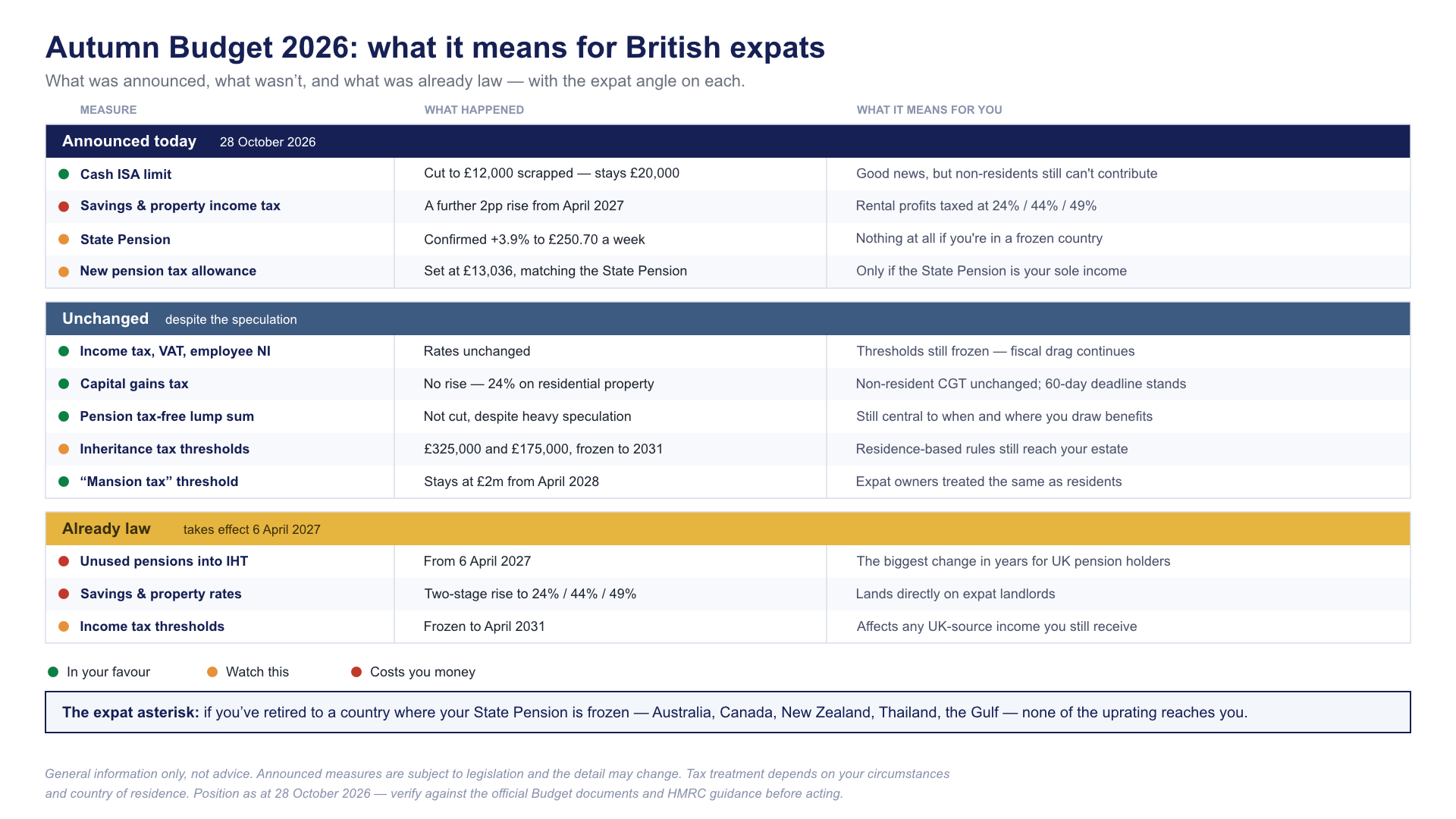
What changed
ISA tax-free limit
The tax-free limit on cash ISAs will stay at £20,000, abandoning plans to reduce it to £12,000, which were due to take effect on 6 April 2027. However, non-residents still cannot contribute to an ISA.
The anti-circumvention rules that were introduced to support the planned cut, such as restrictions on transferring stocks-and-shares ISAs into cash ISAs and a flat 22% charge on interest from cash held in non-cash ISAs, will also be removed. This removes a layer of complexity the industry had criticised.
The Chancellor also announced plans to work with the sector on a new "starter ISA" for first-time savers.
→ ISA rules when moving abroad
Tax rises on savings and property
The Chancellor announced a further two-percentage-point increase on income from savings and property from April 2027. This adds to the two-point rise already legislated last year.
Together, these changes mean tax on property and savings income will rise from 20%, 40%, and 45% today to 24%, 44%, and 49% from April 2027 for basic, higher, and additional rate taxpayers. Scotland and Wales set their own property income rates. The Chancellor said 88% of people will pay no more tax on their savings income.
For expats, this matters if you have UK-source rental income, as it remains taxable in the UK wherever you live. Expat landlords should also consider the Non-Resident Landlord Scheme and non-resident capital gains tax, which has a 60-day reporting deadline.
The State Pension: confirmed
The State Pension increase for April 2027 has been confirmed at 3.9%, raising the full new State Pension to £250.70 a week — roughly £13,036 a year — up from £241.30.
For the first time, the full new State Pension will exceed the £12,570 personal allowance, which has been frozen since 2021 and will remain frozen until 2031. The Government has confirmed that pensioners whose only income is the State Pension will not pay tax on it.
To achieve this, the government will introduce a new pension tax allowance. The Chancellor said: “Pensioners with income up to the value of the full new State Pension will not pay income tax in this parliament."
The new allowance is set at £13,036, matching the full new State Pension, and is expected to rise with State Pension increases during this parliament. It applies only to those whose only income is the State Pension. Anyone with private or workplace pension income on top will still pay tax above the standard threshold.
A note for expats: None of these changes applies if you have retired to a country where your State Pension is frozen. In Australia, Canada, New Zealand, Thailand, much of the Commonwealth, and the Gulf, including the UAE, your pension won't increase, no matter what the Chancellor announced today.
→ The frozen State Pension trap · State Pension 2027
What didn't change
It is important to state this clearly, as there was a lot of speculation:
Income tax, VAT and employee National Insurance rates: Unchanged, in line with the manifesto commitment.
Inheritance tax: No change to the nil-rate band (£325,000) or residence nil-rate band (£175,000), both frozen to April 2031, and no reversal of the April 2026 relief caps.
Capital gains tax: The Chancellor had ruled out a rise ahead of the Budget; rates remain at 24% on residential property gains for higher-rate taxpayers.
The "mansion tax" threshold: Stays at £2 million from April 2028, after the proposed reduction to £1.5 million was ruled out.
The pension tax-free lump sum: The Chancellor decided against cutting the maximum tax-free lump sum from a private pension, despite heavy speculation.
Why it matters to expats: the tax-free element is often central to deciding when and where to draw UK pension benefits.
The changes that matter most weren't announced today
Most Budget coverage overlooks this. Several important changes for expats were already passed and will take effect on 6 April 2027, no matter what is announced today:
Unused pension funds now fall under inheritance tax. For expats with UK pensions, this is the biggest change in years. A pension pot that used to sit outside the IHT net could now face a 40% charge, possibly plus income tax for the beneficiary.
Savings and property income tax rates were already rising by two percentage points to 22%, 42% and 47% — before today's further increase took them to 24%, 44% and 49%.
Income tax thresholds will stay frozen until April 2031, so fiscal drag will continue.
If you have UK pensions or UK property, these changes matter more than today’s headlines.
What to do now
Do not rush
The details matter more than the speech, and the full Budget documents often include qualifications, transitional rules, and start dates that headlines miss. Most of these measures do not require action this week.
Work out what actually affects you
For expats, the key question isn't just what was announced, but what affects your UK-connected assets: UK property, UK pensions, UK-source income, and your estate under the residence-based rules.
Check the dates
Several changes won't take effect until April 2027, or later, so you have time to plan, not worry.
If you would like to understand what today’s Budget means for your situation, speak to Holborn Assets.
All information contained in this article was correct at the time of publication. This article is for informational purposes only and is not financial advice. For personal financial advice, always speak to a regulated professional.
Don’t just take our word for it...
We’re rated 4.8 out of 5 on Feefo, based on verified reviews from real client experiences
 4.8 / 5