Insights
Golden Visas in 2026: Where You Can Still Buy Residency (and Where the Door Has Closed)
4th August 2026
If you last looked at "golden visas" a few years ago, almost everything you remember is now out of date.
In the past three years, the landscape for residency and citizenship by investment has changed more quickly than in the previous decade. Some programmes have closed, prices have gone up, and the EU's last "golden passport" was struck down by a court. Despite these changes, demand has not dropped. In fact, more people are now interested in the programmes that remain.
Here is a clear and up-to-date overview for 2026: what a golden visa really is, which options are no longer available, which ones are still open, and how much they cost. Most importantly, we will explain the common mistakes people make about golden visas.
What a "golden visa" is and what it is not
There is no single legal definition for a "golden visa" because each country uses its own terms. In reality, it usually means one of two different things:
Residency by investment (RBI): A residence permit you get by making a qualifying investment. Usually, you do not have to live in the country or become a tax resident. This is what most people think of when they hear "golden visa."
Citizenship by investment (CBI): Means getting a second passport much faster than through normal naturalisation, in exchange for an investment. This option is rarer, faces more checks, and as of 2025, is no longer available anywhere in the EU.
It is important to remember the difference, since people often mix them up. RBI gives you the right to live in a country, while CBI gives you more travel options and a second nationality.
The doors that have closed
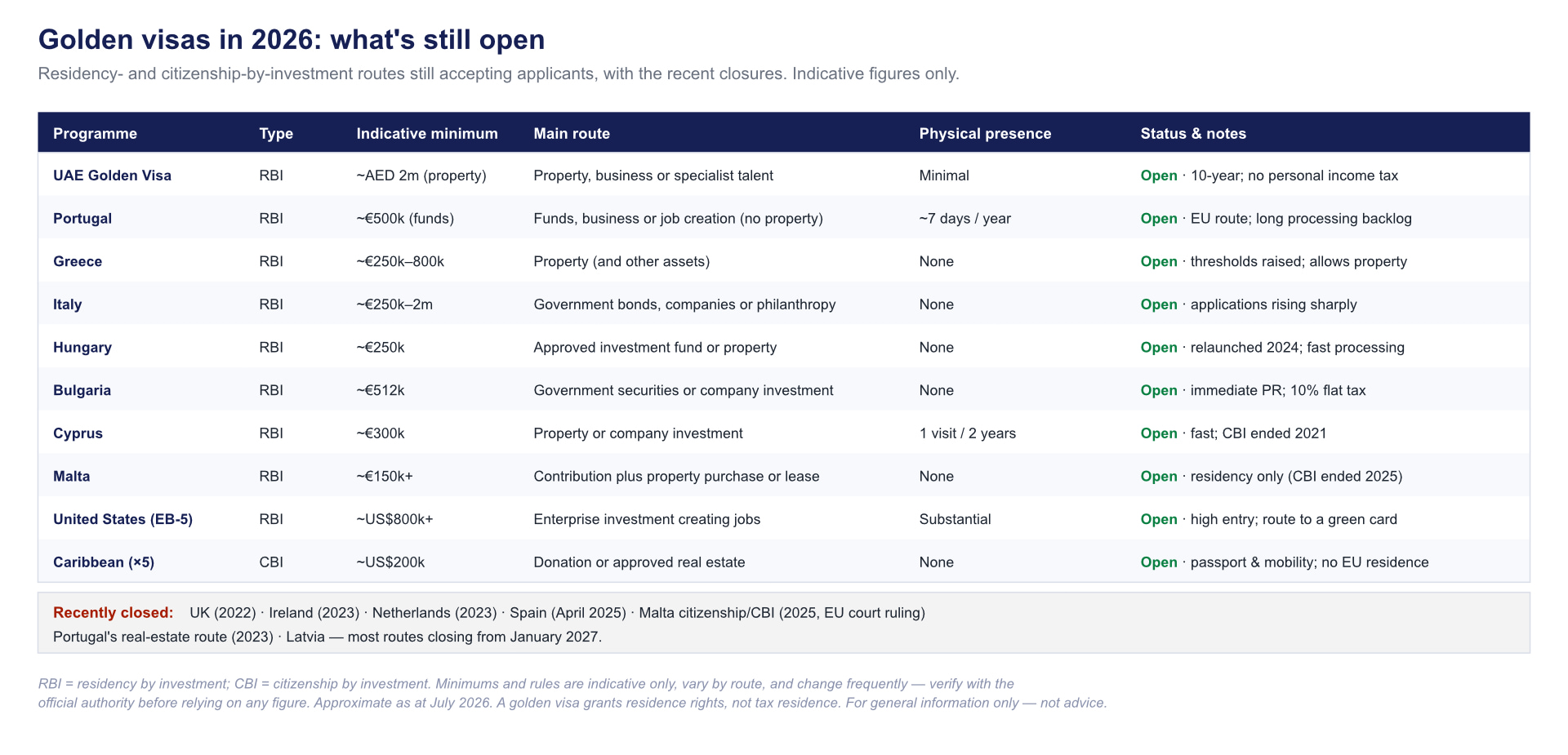
The big story in 2026 is that many options have disappeared. If a relocation firm is still advertising some of these, their information is out of date:
The UK: Ended its Tier 1 Investor visa back in 2022. Ironically, British expats can't buy their way into the UK, so this whole topic is now about looking at other countries.
Ireland: Closed its Immigrant Investor Programme in 2023.
The Netherlands: Stopped taking new applications for its foreign investor residence scheme in 2023.
Portugal: Removed the property route in October 2023. This change ended the classic "buy an Algarve apartment, get residency" era.
Spain: Ended its golden visa completely on 3 April 2025, citing housing pressure. There is no direct replacement.
Malta's citizenship-by-investment scheme: The EU's last golden passport was struck down by the European Court of Justice in April 2025 as incompatible with EU law. Malta's residency programme still exists, but the passport option does not.
Latvia: Decided in mid-2026 to close most of its routes starting January 2027, so investors are now watching the clock.
The trend is clear: the remaining options are fewer, cost more, and are checked much more carefully than they were ten years ago.
What's still open in Europe
Even after many programmes closed, several EU and European options are still active in 2026. These include Portugal, Greece, Italy, Hungary, Bulgaria, Cyprus, Malta (residency), and for now, Latvia.
Here are the headline options for most expats:
Greece
Greece is the most popular EU route, largely because it still has the lowest entry point and still allows property investment. However, the thresholds have been raised twice, and the cheapest option now has extra conditions, so it's not as much of a bargain as before. The citizenship timeline is long, but you only need to spend a little time in the country.
Portugal
Portugal remains the marquee EU option after Spain's exit, but its programme is more limited than many people think. The real estate route is gone, and now you need to invest through funds, research, cultural support, or job creation. Portugal still offers a relatively good citizenship timeline and only requires a small physical presence, but processing times are now famously long.
Italy
Italy has seen a surge in applications as more investors focus there. There is no property route; instead, you invest in government bonds, companies, or philanthropy, and only need to spend a little time in the country.
Hungary
Hungary brought back its investor route in 2024, and it's now known for fast processing. Bulgaria offers a unique immediate-permanent-residency option with a flat 10% tax rate. Cyprus still has a residency programme, with quick processing and only a short visit required. Its citizenship scheme ended in 2021.
If you want an EU passport, the citizenship timelines in countries like Portugal and Greece are what make these routes valuable. Residency can eventually let you settle anywhere in the EU, but these timelines are long and have been getting even longer.
What's thriving outside Europe
As European options have closed, the rest of the market has grown quickly:
The UAE Golden Visa
The UAE is especially relevant for our Gulf-based readers. It offers a long-term (usually ten-year) residence route through property or business/professional criteria, in a place with no personal income tax. For expats already living in Dubai or Abu Dhabi, it's often the most natural choice.
The United States EB-5
The US offers two main routes: the EB-3 and the EB-5 visa. Both give you residency in the United States. The EB-5 is much more expensive, but it does not require you to work for a US employer, which makes it attractive for investors.
The Caribbean citizenship-by-investment programmes
Five nations, including St Kitts & Nevis and Dominica, now have a shared minimum of about US$200,000 and offer real passport mobility (visa-free or visa-on-arrival access to the Schengen Area and the UK). However, they do not offer any EU residence rights. These programmes are about mobility, not settling in Europe.
One upcoming change to note is the EU's ETIAS travel-authorisation system, which is set to launch in late 2026. Some in the industry expect this will mean more scrutiny for holders of investment-based passports.
The part expats most often get wrong: a golden visa is not a tax status
This is the point worth underlining, because it's where costly misunderstandings happen.
A golden visa gives you the right to live somewhere. It does not, by itself, make you a tax resident there, and it definitely doesn't change your UK tax position.
Whether you're UK tax resident is decided by the Statutory Residence Test, based on your days and ties in the UK — not by which residence permits you happen to hold.
You can have a golden visa and still be UK-resident and taxable if your life keeps you tied to Britain. Likewise, holding one doesn't automatically make you a tax resident in the country that issued it. A golden visa can be useful for mobility, lifestyle, or estate planning, but using it as a tax plan is a mistake.
If tax is your goal, the questions that actually matter are your residence and your estate position. We cover these in our articles on the most tax-friendly countries for expats and UK inheritance tax for expats.
A word on due diligence and risk
The closures of the past three years have taught an important lesson: programme stability is now a key part of the decision.
Spain gave little warning, Latvia's routes are closing on a set date, and Malta's passport scheme was ended by a court. A route that looks perfect today can be withdrawn, so consider how established and politically secure a programme is, not just its price and perks.
A few other things to check before committing:
The headline figure is rarely the real cost: Government fees, legal and due diligence charges, and ongoing maintenance or minimum holding requirements can add a lot to the sticker price.
Vetting is now much stricter: Source-of-funds and background checks are far more thorough than they were a decade ago, so expect scrutiny and allow time for it.
Be careful with anyone marketing a closed programme: If a company is still advertising the Spain golden visa or Portugal’s old real estate route, be cautious about anything else they say.
A passport does not guarantee frictionless travel forever: The EU's new ETIAS system may add checks for investment-based passport holders, so the mobility a CBI gives you today could change in a few years.
How to think about choosing
Start from what you actually want the visa to do:
Somewhere to live now (e.g. you're already in the Gulf): The UAE Golden Visa is often the obvious fit.
A long-term route to EU settlement or a passport: The surviving EU residency programmes (Portugal, Greece, Italy) are the field — but weigh the long, lengthening citizenship timelines and the risk of further rule changes.
Global mobility and a second passport, fast: The Caribbean CBI programmes, accepting that they carry no EU residence rights.
Then pressure-test three things before committing: the real, current cost and rules (they change often); the physical-presence and tax implications of actually using it; and the programme's stability, given how many have closed at short notice.
Because immigration rules are complex, high-value and fast-moving, and because the tax consequences sit alongside them, this is firmly territory for qualified, up-to-date advice rather than a decision made on a headline.
If you'd like to think through how a golden visa fits your wider financial and tax picture in 2026, speak to Holborn Assets — and we'll work alongside a qualified immigration specialist on the visa itself.
All information contained in this article was correct at the time of publication. This article is for informational purposes only and is not financial advice. For personal financial advice, always speak to a regulated professional.
Don’t just take our word for it...
We’re rated ‘Excellent’ on Trustpilot, based on thousands of verified reviews from real client experiences