Insights
How Often Should You Check Your Portfolio? You're Probably Asking the Wrong Question
21st July 2026
Here's a strange truth about investing: the more often you look at your portfolio, the worse it will seem — even if it's quietly growing the whole time.
This isn’t just a matter of perception. It’s simple math, and it’s why asking "how often should I check my portfolio?" misses the point. The real questions are what you’re looking for and how you’ll use that information.
For expats, there’s an extra factor that makes checking even more confusing. Let’s break down all three points.
Why looking more often makes things look worse
Markets tend to rise more than they fall over time, but the progress isn’t smooth. There are plenty of small daily ups and downs, the occasional sharp drop, and a general upward trend that only becomes clear when you look at the bigger picture.
That means the answer to "is my portfolio down right now?" depends enormously on how often you ask. Based on the long-run history of the US stock market, the odds of catching a loss at any given moment look roughly like this:
Check every day, and it’s almost like flipping a coin. You’ll see a loss on about 47% of days.
Check monthly, and the chance of seeing red falls to around 37%.
Check once a year, and it drops to roughly one in four.
Check every five years, and it's about one in eight.
Check every ten years, and only around 6% of those periods have been negative.
Check every twenty years, and history shows you would never have seen a loss.
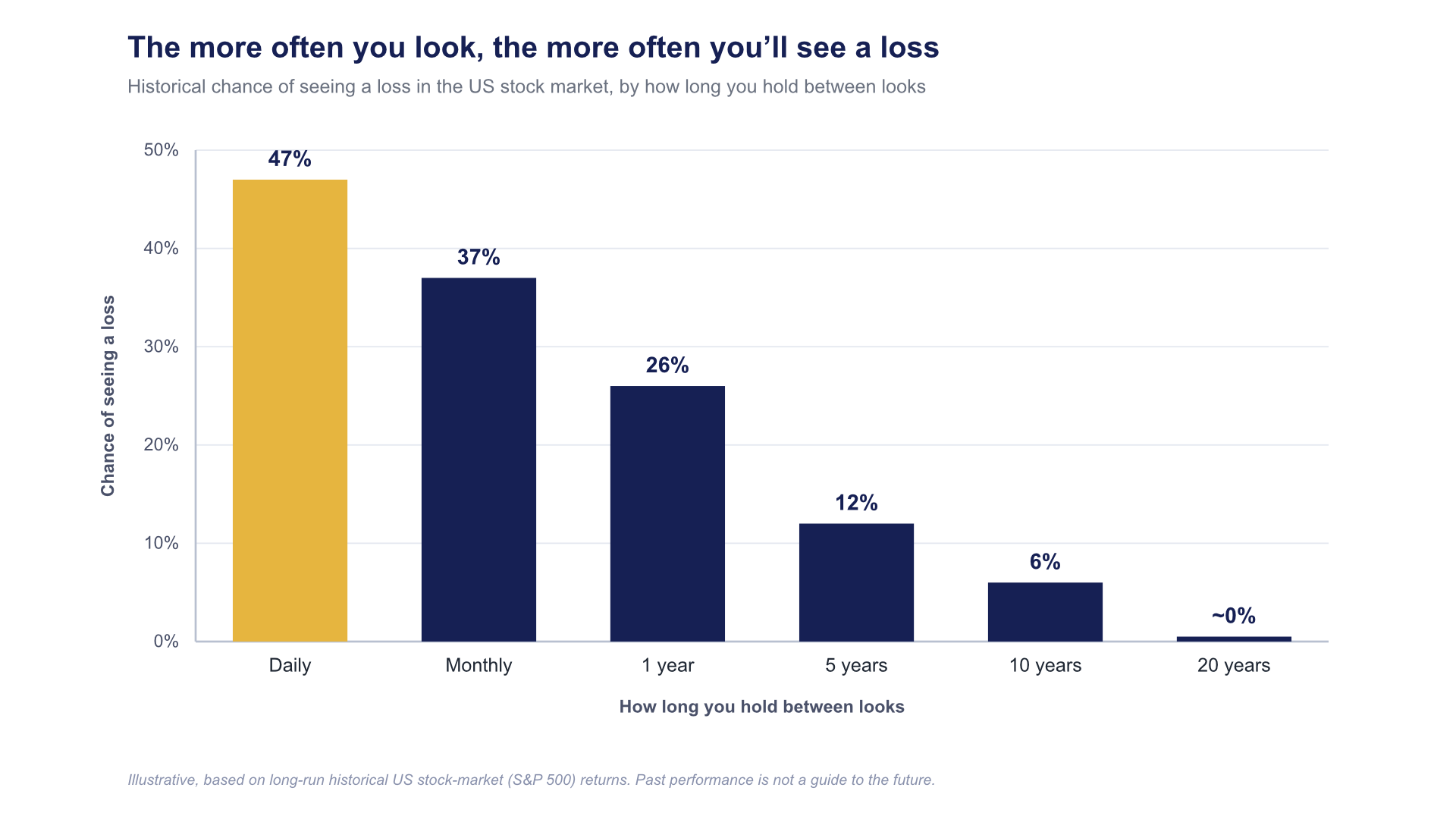
Take another look at that list, because it sums up the whole article. Your actual returns are the same in every example since it’s the same market. The only thing that changes is how often you check. Checking more often doesn’t lower your returns; it just increases the number of times you’ll feel disappointed.
Behavioural economists call this problem myopic loss aversion. We feel the pain of a loss much more strongly than the pleasure of a similar gain. So, the more often we see short-term drops, the more anxious we get, and anxious investors often make costly mistakes.
Someone checking every hour during a downturn isn’t better informed than someone checking twice a year. They’re just more likely to panic and sell at the worst possible time.
The three things people call "checking"
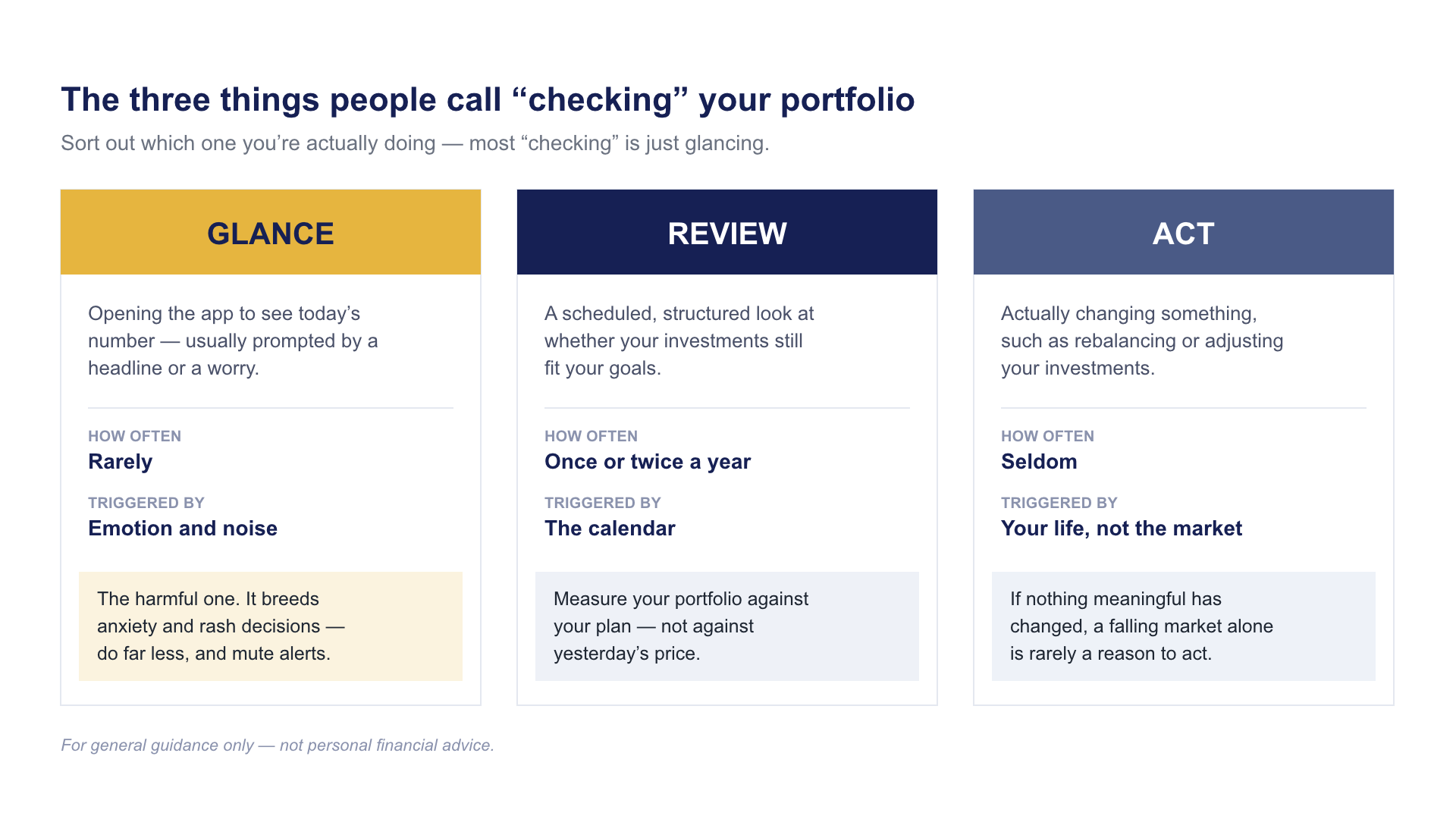
Part of the problem is that "checking your portfolio" describes three completely different things that get lumped together. Sorting them out is more helpful than choosing a set number of times to check each year.
Glancing
This is the emotional one: opening the app to see today’s number, usually because of a headline or a nagging worry. It feels productive, but it isn’t.
Glancing is where myopic loss aversion takes hold, and it’s the activity you should do much less often. A good first step is to turn off price notifications, so the market stops grabbing your attention.
Reviewing
This is the purposeful one: a scheduled, structured look, maybe once or twice a year, to see if your investments are still doing what you want them to do.
Are you still on track for your goals? Is the mix still right for your time frame and your comfort with risk? Reviewing means measuring your portfolio against your plan, not against yesterday’s closing price.
Acting
This is the rare one: actually making a change. The key point is that you should act because of your own circumstances or a scheduled process, almost never because of a market move. This leads to a much more important question than how often you check.
The question that actually matters: has anything changed?
Most long-term investors don't need to do anything just because markets have moved. Genuine reasons to act are usually about you, not the market: your goals have shifted, your time horizon has shortened, you're approaching retirement, a big purchase is coming, or your circumstances have changed.
Some do-it-yourself investors also rebalance from time to time to keep their asset mix in line with their original plan, but that’s a scheduled, rules-based process, not a reaction to the news. If you're wondering whether your balanced portfolio still makes sense, read our article for the honest answer.
If nothing meaningful has changed, a falling market on its own is rarely a reason to act. It's just the price of admission for the long-term returns that reward staying invested.
Of course, this is not a recommendation to hold, sell or buy anything. What’s right depends entirely on your own situation, which is exactly why the "has anything changed?" test is personal.
The expat's extra problem: you're seeing double
Here's the bit the standard "check less often" articles miss entirely, because they're written for people whose money lives in one currency.
If you’re an expat, your portfolio is probably moving for two reasons at once: the markets and the exchange rate.
If you earn or think in pounds but hold investments in dollars, or vice versa, then every time you check, you’re seeing both the market’s movement and the currency’s movement together.
That can be very misleading. Your investments might have had a calm week, but your balance in pounds jumps around because the pound got stronger against the dollar. You’d see a "loss" that has nothing to do with your investments at all, just noise from the currency.
Checking too often already makes the ups and downs look worse. For a cross-border investor, it can make things look twice as volatile, turning a calm market into a chart that looks much more alarming.
We explore the currency side of expat finances more fully in our pieces on the cost of moving money and managing currency exposure.
The takeaway isn't to worry more. It’s to realise that a big part of what makes an expat portfolio look jumpy is just currency changes, and reacting to them usually means reacting to nothing important.
The cost of checking too often — even if you never trade
You might think none of this applies to you because you never actually trade on impulse. But over-checking has a cost even for the disciplined.
Watching every market wobble slowly wears you down: it raises stress, can cost you sleep, and, most importantly, it quietly erodes your conviction.
Each time you ride out a dip while watching it, you use up a bit of your resolve. And resolve is limited.
The investor who watches obsessively for years is often the one who finally gives in during the next big downturn, after using up their patience on many smaller dips that didn’t matter. Doing less isn’t laziness; it’s a way to protect the discipline you’ll need when it matters most.
So how often should you look?
If you want a practical routine instead of a strict rule: glance rarely (and turn off the notifications that prompt you), review on a schedule—once or twice a year is enough for most people—and act only when your life, not the market, gives you a reason. That’s it.
There’s also a subtle reason to have an adviser, and it’s as much about behaviour as it is about technical expertise.
A good adviser acts as a circuit-breaker between you and the panic button. They provide scheduled reviews so you don't feel the need to glance, and a steady second opinion in the moments when markets are loud, and the temptation to do something — anything — is strongest.
Often the most valuable thing they do is help you sit still.
In short
The honest answer to "how often should I check my portfolio?" is: less often than you probably do, and for better reasons.
Frequent checking won’t improve your returns. It will only show you more losses, tempt you into more mistakes, and wear down the patience that long-term investing depends on. For expats, with currency adding extra noise, that’s even more true.
If you’d like a thoughtful, scheduled review of whether your investments are still doing their job, the kind that removes the urge to check in between, a conversation with a regulated adviser is a good place to start.
All information contained in this article was correct at the time of publication. This article is for informational purposes only and is not financial advice. For personal financial advice, always speak to a regulated professional.
Don’t just take our word for it...
We’re rated ‘Excellent’ on Trustpilot, based on thousands of verified reviews from real client experiences